FDA Generic Drug Safety: What You Need to Know About Quality and Cost
When you pick up a FDA generic drug, a medication approved by the U.S. Food and Drug Administration that contains the same active ingredient as a brand-name drug. Also known as generic medication, it works the same way, costs far less, and is held to the same strict standards. But here’s the thing: many people still worry they’re getting a lesser version. That’s not true. The FDA requires generics to have the same strength, dosage form, route of administration, and performance as the brand-name version. They don’t cut corners on quality.
Behind every FDA-approved generic is a full review of the manufacturing process, ingredients, and how the drug behaves in the body. The active ingredient must be identical, and the inactive ingredients — like fillers or dyes — must be safe and not affect absorption. The FDA doesn’t require new clinical trials for generics, but they do test them in labs and inspect factories. In fact, many brand-name companies make their own generics once the patent expires. So if you’re skeptical, ask: who’s really making it? It’s often the same plant, same machines, same people.
What about safety? The FDA tracks adverse events for both brand and generic drugs the same way. If a generic causes more side effects, they’d know — and they’d pull it. There’s no evidence that generics are riskier. The real difference? Price. In 2023, generics saved Americans $445 billion. That’s not a guess — it’s official data. For people on fixed incomes, chronic conditions, or just trying to stretch a paycheck, that matters. And it’s not just about saving money — it’s about access. Without generics, millions couldn’t afford their meds at all.
Some confusion comes from packaging or pill shape. A generic might look different, but that’s just the inactive ingredients. Or maybe you heard a story about a generic not working as well. That’s rare, and usually tied to how the drug is taken — with food, on an empty stomach, or at the wrong time. It’s not the drug itself. The FDA even checks bioequivalence: how fast and how much of the drug gets into your bloodstream. If it’s not within 80–125% of the brand, it doesn’t get approved.
And while patents and legal battles delay generics — like in the Hatch-Waxman Act, a 1984 law that balanced innovation and access by letting generics enter after patents expire — once they do, the system works. The Orange Book, the FDA’s official list of approved drug products with therapeutic equivalence evaluations tells you which generics are interchangeable. You don’t need to be a pharmacist to read it. Your pharmacist can show you.
So why do doubts linger? Because change is scary. Because ads make brand names feel like the only real option. But the science doesn’t lie. If your doctor prescribes a generic, or your pharmacy swaps it in — you’re not getting second-best. You’re getting the same medicine, at a fraction of the cost. And that’s the whole point of the FDA’s system: safety, effectiveness, and fairness for everyone.
Below, you’ll find real stories, hard numbers, and clear breakdowns of how generics actually work — from patent cliffs to savings reports, from patient fears to pharmacy tricks. No fluff. Just what you need to know to trust your meds and save your money.
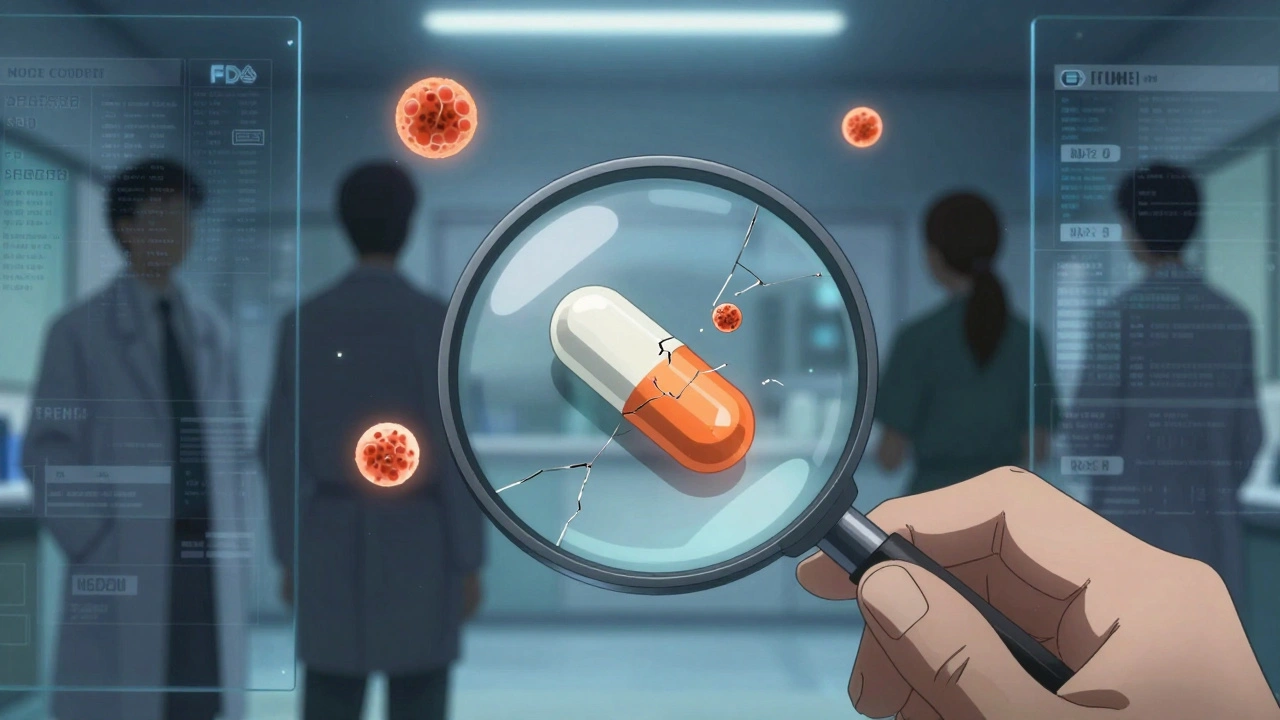
How the FDA Monitors Generic Drug Safety After Approval
- Date: 2 Dec 2025
- Categories:
- Author: David Griffiths
The FDA doesn't stop monitoring generic drugs after approval. Learn how it tracks quality issues, adverse events, and manufacturing flaws using real-world data, signal detection, and emerging tech like AI to keep patients safe.