Steroid Acne Checker
Check your skin condition
Answer these questions to identify your specific skin condition and get treatment recommendations based on your symptoms.
Your Condition
Results will appear here after you click "Get My Results"
When you start taking steroids-whether it’s for asthma, an autoimmune disease, or even bodybuilding-you might not expect your skin to rebel. But for many people, a wave of small, uniform red bumps appears on the chest, back, or face after a few weeks. This isn’t just regular acne. It’s steroid-induced acne, a direct side effect of corticosteroid or anabolic steroid use. Unlike the occasional pimple from hormones or stress, this type of breakout is triggered by how steroids interact with your skin’s natural bacteria and immune response. And it’s more common than you think.
What Makes Steroid Acne Different?
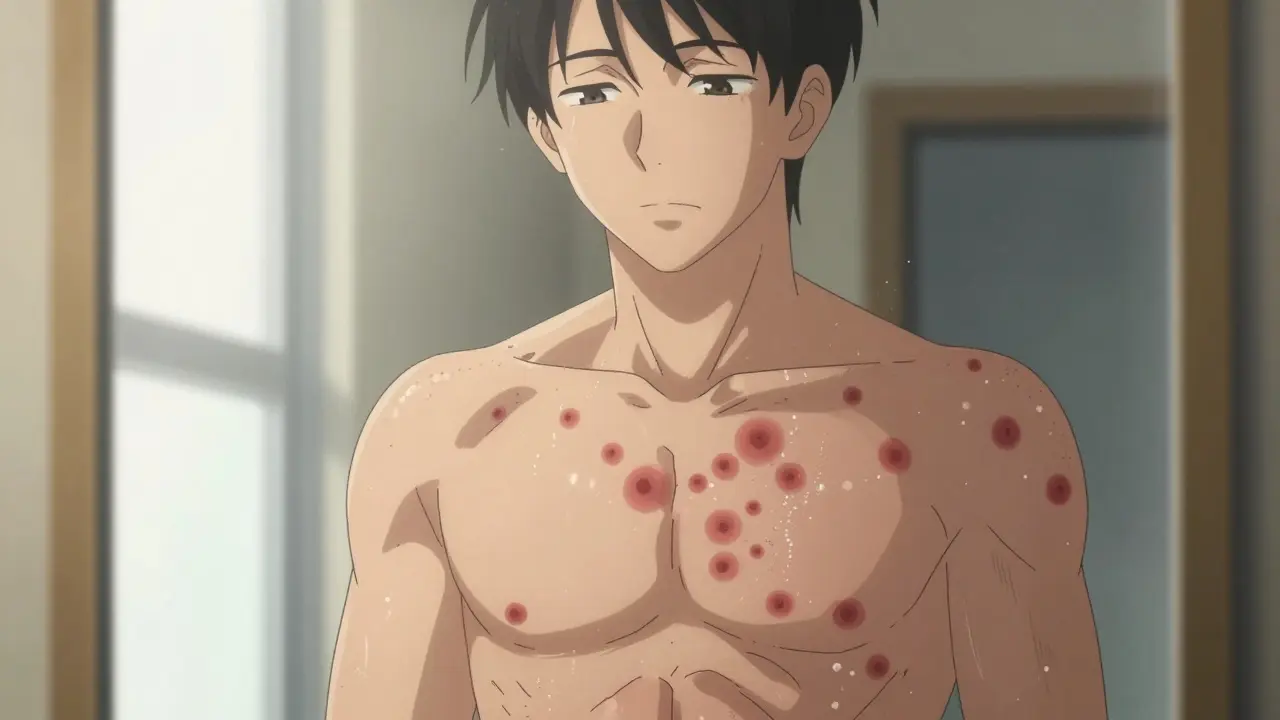
Steroid-induced acne doesn’t look like the classic teenage zit. It’s often made up of dozens of identical, inflamed bumps-no blackheads at first, just dense clusters of red papules. These show up mostly on the chest and upper back, not just the face. In about 30-40% of cases, it’s not acne at all-it’s Malassezia folliculitis, a fungal infection caused by yeast overgrowth triggered by steroids. These lesions are itchy, tiny, and look like a rash of identical whiteheads.
What’s happening inside your skin? Steroids disrupt your skin’s natural balance. They increase oil production, weaken your skin’s barrier, and alter how your immune system responds to bacteria like Propionibacterium acnes. Recent research shows steroids boost a receptor called TLR2 on skin cells. When this receptor gets overstimulated by normal skin bacteria, it turns on inflammation pathways-exactly like acne, but faster and more widespread.
Onset usually happens 4 to 6 weeks after starting steroids. The higher the dose-think prednisone at 20mg/day or more-the faster and worse the breakout. Teens and young adults are more likely to get it, but anyone on long-term steroids can develop it. Even people who’ve never had acne before can suddenly be covered in bumps.
Topical Treatments That Actually Work
If you’re on steroids for a medical condition and can’t stop them, you need treatments that work while you’re still taking them. The most proven option? Tretinoin 0.05%. Back in 1973, researchers gave 12 patients with steroid acne a daily application of tretinoin. After two to three months, 85-90% of their lesions cleared-even though they kept taking steroids. Today, dermatologists still recommend it as first-line treatment.
Start slow. Apply a pea-sized amount to affected areas once a night, every other night, to avoid irritation. After a week or two, if your skin tolerates it, move to nightly use. Don’t expect overnight results. It takes 6 to 12 weeks to see full improvement. Combine it with a gentle, non-comedogenic moisturizer. Steroids dry out your skin, and dry skin means more irritation and more breakouts.
For bacterial acne, benzoyl peroxide 5% washes help. Use them 2-3 times a week on the chest and back. Don’t scrub. Just massage it in, leave it on for a minute, then rinse. Benzoyl peroxide kills acne bacteria and reduces inflammation. Avoid harsh scrubs, loofahs, or exfoliating brushes-they make things worse.
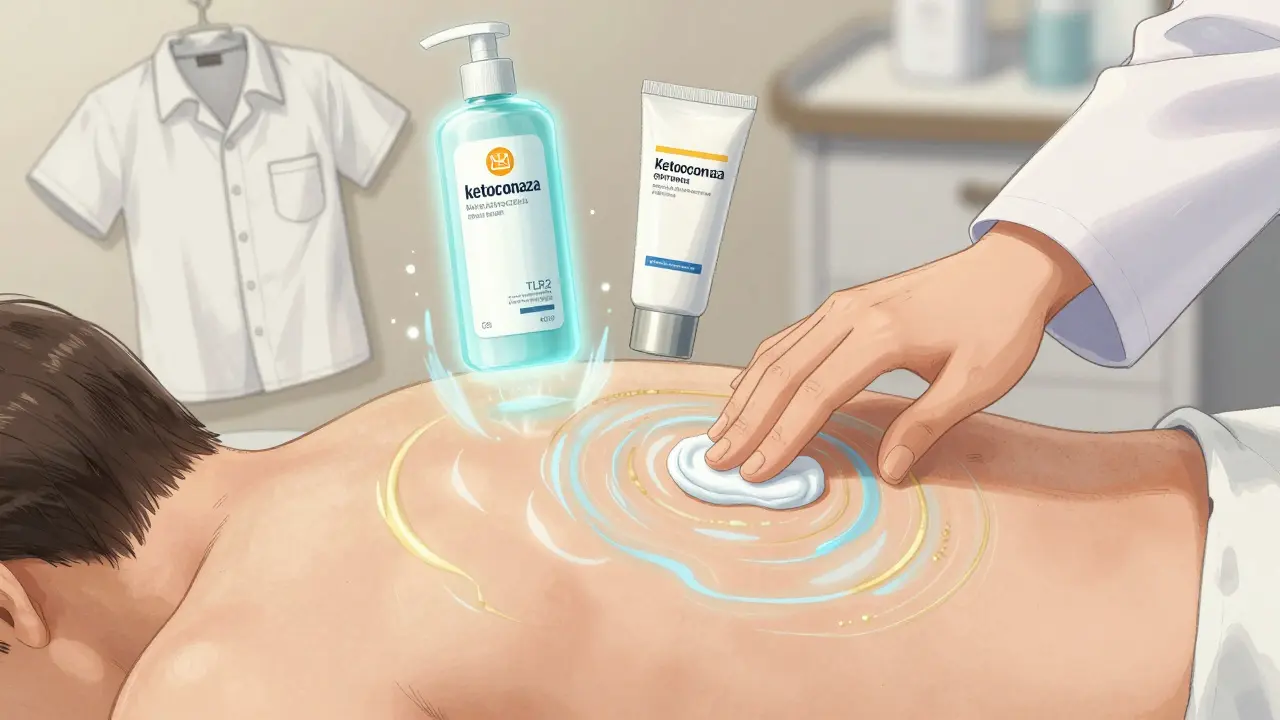
If your breakout is itchy and looks like a rash of tiny whiteheads, you likely have Malassezia folliculitis. Try a ketoconazole 2% shampoo (the kind for dandruff). Wet your skin, apply the shampoo to your chest and back, leave it on for 5-10 minutes, then rinse. Do this 2-3 times a week for 4 weeks. Many patients see 70-80% improvement. Selenium sulfide 2.5% shampoo works similarly and is another good option.
Oral Options When Topicals Aren’t Enough
If topical treatments don’t cut it after 8-12 weeks, you might need oral help. For moderate to severe cases, doxycycline 100mg twice daily is often prescribed. It reduces inflammation and kills acne bacteria. But don’t take it longer than 3-4 months. Antibiotic resistance is real, and long-term use can mess with your gut health.
For women, oral contraceptives with ethinyl estradiol and a progestin (like drospirenone) can help. They lower androgen levels, which reduces oil production. Spironolactone, a blood pressure drug that also blocks androgens, is another option. Start at 25mg daily and increase to 50mg if needed. It’s not FDA-approved for acne, but dermatologists use it daily for hormonal breakouts.
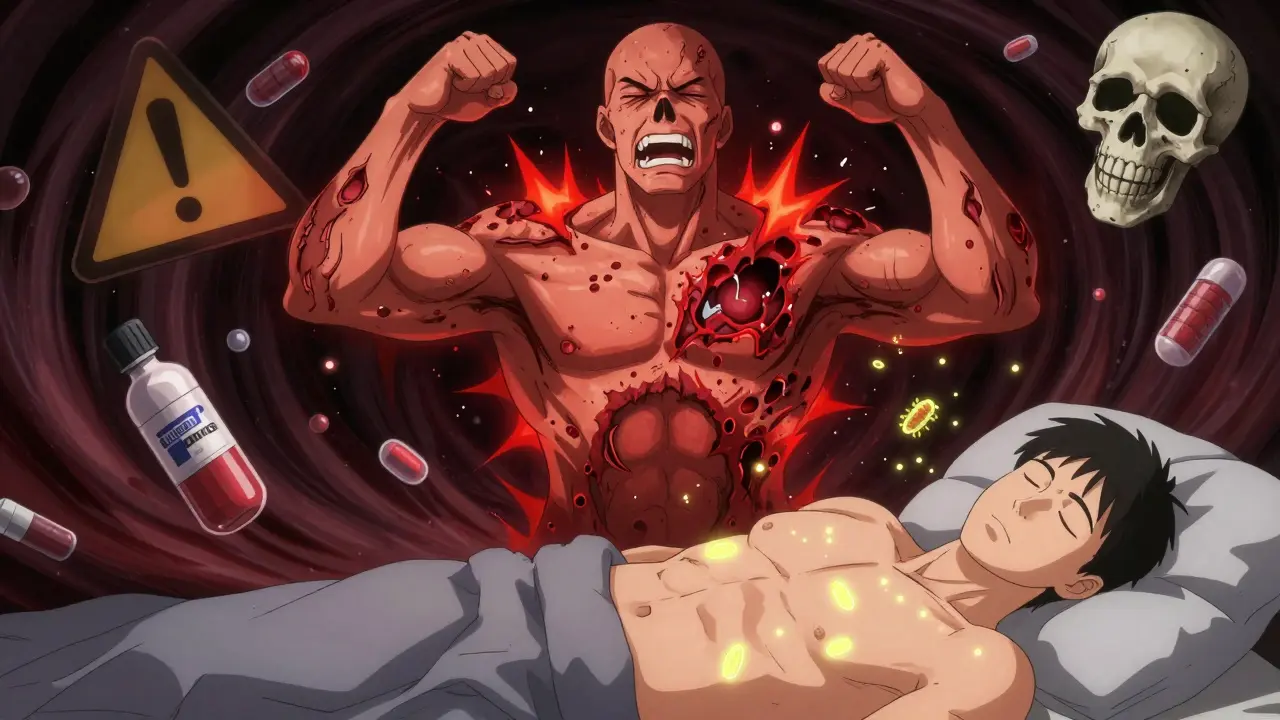
For stubborn cases, oral isotretinoin (Accutane) is powerful. It shrinks oil glands, dries up acne, and prevents scarring. But here’s the catch: if you’re using anabolic steroids for bodybuilding, isotretinoin can trigger a dangerous condition called acne fulminans. This isn’t just bad acne-it’s painful, ulcerated lesions, fever, and joint pain. Two bodybuilders in a 2021 case study ended up hospitalized after starting isotretinoin during a steroid cycle. Dermatologists now warn: never use isotretinoin while on anabolic steroids.
Lifestyle Changes That Make a Difference
Treatment isn’t just about creams and pills. Your daily habits matter just as much.
- Wear loose, breathable clothing. Tight shirts and synthetic fabrics trap sweat and oil. Cotton is your friend.
- Shower right after workouts. Sweat clogs pores. Don’t let it sit on your skin for hours.
- Use non-comedogenic products. Check labels. Avoid anything labeled "oil-free"-that doesn’t mean non-pore-clogging. Look for "non-comedogenic" or "won’t clog pores."
- Don’t pick or squeeze. You’ll cause more inflammation and risk scarring.
- Protect your skin from the sun. Steroids and acne treatments make you more sensitive. Use a mineral sunscreen (zinc oxide or titanium dioxide) daily.
Also, avoid heavy moisturizers with lanolin, coconut oil, or cocoa butter. These can feed the yeast that causes Malassezia folliculitis. Stick to water-based, fragrance-free lotions.
When Will It Go Away?
If you stop taking steroids, your skin usually clears up in 4 to 8 weeks. But if you’re on steroids for a life-threatening condition-like after a transplant or for severe lupus-you can’t just quit. That’s why treatment has to be smart and sustainable. Topical tretinoin and antifungal washes are your best allies here. They work without interfering with your main treatment.
For bodybuilders using anabolic steroids, the outlook is trickier. The acne won’t go away until you stop the drugs. And even then, scarring can linger. That’s why prevention matters more than treatment. If you’re using steroids to build muscle, know this: your skin will pay the price. And once you start, the damage can be hard to undo.
What’s New in Research?
Scientists are now looking at the TLR2 pathway as a target for new treatments. Early trials with topical TLR2 inhibitors show a 65% reduction in lesions after 12 weeks. That’s promising. Companies are also testing products with "good" bacteria, like ammonia-oxidizing bacteria, to restore your skin’s natural microbiome after steroid disruption.
The American Academy of Dermatology now recommends starting treatment within 8 weeks of breakout onset. Waiting longer increases scarring risk. And with telemedicine platforms like Curology and Apostrophe seeing a 30% rise in steroid acne cases since 2020, more people are getting help before it’s too late.
But here’s the hard truth: there’s no magic fix. Steroid-induced acne is stubborn. It needs patience, consistency, and sometimes tough choices. Whether you’re managing a chronic illness or trying to build muscle, your skin deserves attention-not just as a side effect, but as part of your health.
Can steroid-induced acne be treated without stopping steroids?
Yes. For people on long-term corticosteroids for medical reasons, topical treatments like tretinoin 0.05% and benzoyl peroxide washes are effective without interfering with steroid therapy. Antifungal shampoos (ketoconazole or selenium sulfide) work well for Malassezia folliculitis. The goal is to manage the acne while keeping necessary medical treatment ongoing.
Is isotretinoin safe for steroid acne?
It’s effective for corticosteroid-induced acne, but dangerous for anabolic steroid users. Studies show isotretinoin can trigger acne fulminans-a severe, ulcerated form of acne with fever and joint pain-in people using bodybuilding steroids. Dermatologists strongly advise against using isotretinoin during or immediately after anabolic steroid cycles. Always disclose all steroid use to your doctor before starting isotretinoin.
Why does steroid acne appear mostly on the chest and back?
The chest and back have a higher density of sebaceous (oil) glands compared to the face. Steroids increase oil production, and these areas trap sweat and heat more easily, creating the perfect environment for clogged pores and bacterial or fungal overgrowth. Facial acne is less common because the skin there is thinner and more sensitive to irritation, so breakouts tend to be less dense.
How long does it take for steroid acne to clear?
With treatment, you’ll start seeing improvement in 6-8 weeks. Full clearance usually takes 12 weeks or more. If you stop steroids, the acne typically resolves within 4-8 weeks. Without treatment, it can last as long as the steroid use continues-and may leave permanent scars if not managed early.
Can I use over-the-counter acne products for steroid acne?
Most OTC products won’t work well. Standard acne treatments target hormonal acne, not steroid-triggered inflammation or fungal overgrowth. Benzoyl peroxide washes and tretinoin (available by prescription) are the most effective. Avoid products with alcohol, menthol, or strong fragrances-they irritate steroid-damaged skin. Always consult a dermatologist before trying new products.
Remember: steroid-induced acne isn’t your fault. It’s a biological response to powerful medication. The key is early, targeted treatment-not punishment, not scrubbing, not waiting it out. Your skin is part of your health. Treat it like it matters.