
When you hear the word obesity, most people think of weight alone. But for millions of people, it’s not just about the number on the scale-it’s about what that weight is doing to your body behind the scenes. Obesity doesn’t live in isolation. It triggers a chain reaction, quietly setting the stage for three life-altering conditions: type 2 diabetes, heart disease, and obstructive sleep apnea. Together, they form a dangerous triad that doesn’t just add up-it multiplies risk. And the worst part? Many people don’t even know they’re caught in it.
The Hidden Link Between Weight and Sleep
If you’re overweight and constantly tired, it’s easy to blame your job, your kids, or just "getting older." But there’s a medical reason your body never feels rested: obstructive sleep apnea (OSA). In fact, 86% of obese people with type 2 diabetes also have OSA, according to the SLEEP-AHEAD study. It’s not coincidence-it’s cause and effect. Here’s how it works: extra fat, especially around the neck and belly, crowds your airway. When you lie down to sleep, the muscles in your throat relax. With less space to breathe, your airway collapses. You stop breathing-sometimes dozens of times an hour. Your brain jolts you awake just enough to restart breathing, but never enough for real rest. This cycle repeats all night. You wake up exhausted, even if you slept eight hours. The numbers don’t lie. Each extra point on your BMI increases your risk of OSA by 14%. A waistline over 40 inches for men or 35 inches for women is a stronger predictor of OSA than BMI alone. And here’s the kicker: OSA doesn’t just make you sleepy. It raises your blood pressure, spikes your stress hormones, and makes insulin resistance worse. That means your body struggles to control blood sugar-even if you’re taking medication.Why Fat Tissue Turns Against You
Fat isn’t just padding. It’s active tissue that sends signals. In obesity, fat cells grow too big and too many, and they start releasing inflammatory chemicals. Think of them as tiny alarm bells going off all over your body. These signals make your muscles and liver resistant to insulin-the hormone that moves sugar from your blood into your cells. That’s how obesity leads directly to type 2 diabetes. It’s not just about eating too much sugar. It’s about how your body responds to fat. Obese individuals have 30-50% higher levels of inflammatory markers like C-reactive protein and interleukin-6. That chronic inflammation doesn’t just mess with your metabolism. It damages your blood vessels, speeds up plaque buildup, and makes your heart work harder. And here’s where it gets worse: OSA makes this worse. Every time you stop breathing during sleep, your oxygen drops. That triggers more inflammation and stress hormones like cortisol. The result? Your blood sugar spikes overnight, even if you didn’t eat. Studies show people with severe OSA have 25-30% more insulin resistance than those without it. That’s why many people with diabetes don’t see improvement-until they treat their sleep apnea.The Silent Killer in Your Chest
Heart disease isn’t just about high cholesterol or eating fried food. For someone with obesity, diabetes, and sleep apnea, it’s a perfect storm. Obesity forces your heart to pump harder. Left ventricular hypertrophy-thickening of the heart muscle-happens in up to 20% of severely obese people. OSA causes nightly blood pressure surges of 15-25 mmHg. These spikes don’t just wake you up-they scar your arteries. Add diabetes into the mix, and your blood vessels become brittle and clogged faster. The data is alarming. People with all three conditions have a 3.2-fold higher risk of heart attack than those without. If you have obesity and OSA, your risk of heart failure is 2.3 times higher. Add diabetes, and that risk jumps to 3.7 times. And it’s not just heart attacks-stroke risk goes up by 68% with severe OSA, even after adjusting for weight. A 2022 study in Circulation found that untreated OSA in obese diabetic patients increases cardiovascular death by 86%. That’s not a small number. It’s a wake-up call. OSA isn’t just a sleep problem-it’s a heart problem in disguise.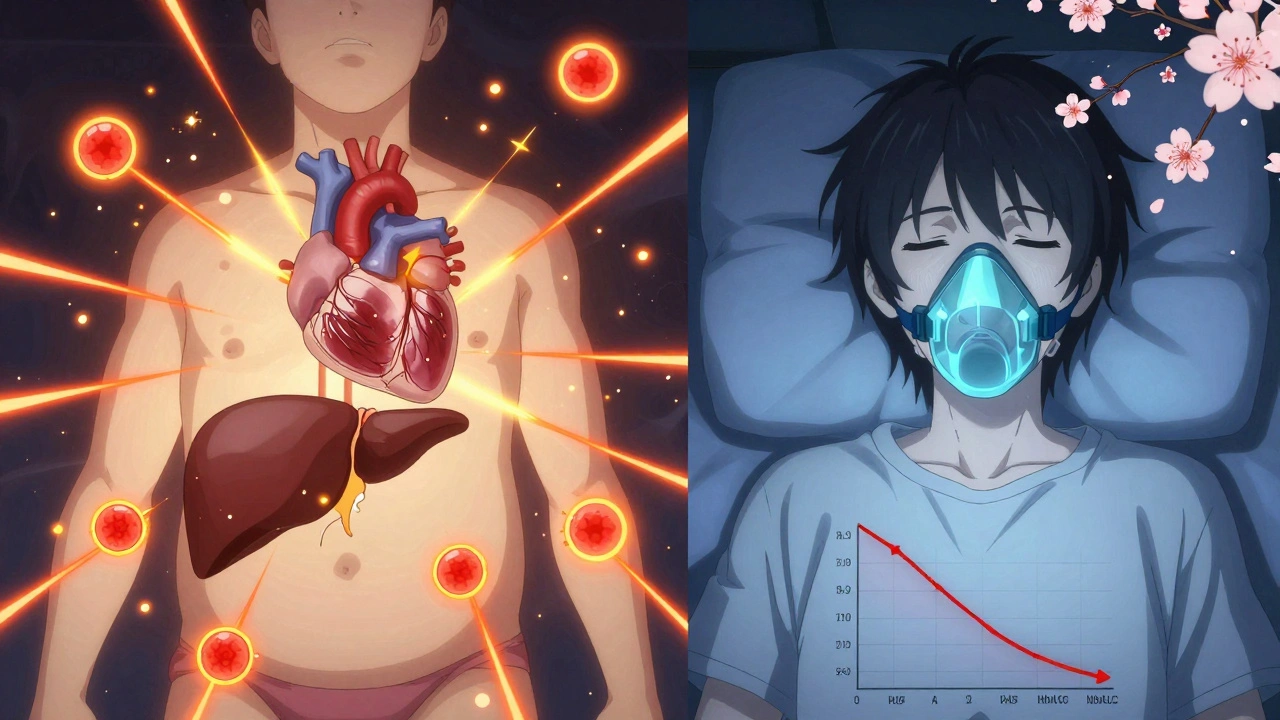
Breaking the Cycle: What Actually Works
The good news? This triad isn’t a life sentence. It’s a cycle-and cycles can be broken. The most powerful tool you have? Weight loss. Losing just 10-15% of your body weight cuts OSA severity in half. That’s not a guess-it’s from real studies. One person who weighed 280 pounds and lost 30 pounds saw their apnea-hypopnea index (AHI) drop from 42 to 18. That’s the difference between severe and mild OSA. But weight loss alone isn’t always enough. If you have moderate to severe OSA, CPAP (continuous positive airway pressure) therapy is the gold standard. It’s a machine that blows gentle air through a mask to keep your airway open. Studies show that using it 4-6 hours a night reduces heart events by 28% in people with diabetes and OSA. Still, many people quit CPAP. Why? Mask discomfort, claustrophobia, or just feeling like it’s too much work. But newer masks are lighter, quieter, and more comfortable. And if CPAP doesn’t work for you, there are alternatives-like oral appliances or the newer hypoglossal nerve stimulator, which gently wakes your tongue muscle to keep your airway open.Getting Screened Before It’s Too Late
Most people with this triad go undiagnosed. Why? Doctors often treat one condition at a time. You see your endocrinologist for diabetes. Your cardiologist checks your blood pressure. But who asks about your sleep? The American Diabetes Association now recommends that everyone with type 2 diabetes and a BMI over 30 be screened for OSA. The tool? The STOP-Bang questionnaire. It asks simple questions: Do you snore? Do you feel tired during the day? Do you have high blood pressure? If you score 3 or higher, you need a sleep study. Don’t wait for symptoms to get worse. If you’re overweight and have diabetes, or if you’re always tired despite sleeping enough, get checked. A sleep study isn’t scary-it’s a simple overnight test. And if you’re diagnosed, treatment can change your life.
Real People, Real Results
One woman in Melbourne, 54, had type 2 diabetes for five years. Her HbA1c stayed stuck at 8.5%. She took her meds, ate "healthy," but still felt drained. Her doctor finally asked about snoring. She admitted she woke up gasping. A sleep study confirmed severe OSA. She started CPAP. Six months later, her HbA1c dropped to 7.4%. She lost 3.2 kilograms. She started walking again. "I didn’t realize my sleep was making my diabetes worse," she said. Another man, 61, lost 18% of his body weight after bariatric surgery. His OSA went from severe to gone. His blood pressure normalized. He stopped three medications. "I didn’t know I could feel this good again," he told his doctor. These aren’t outliers. They’re the rule-if you treat the whole picture, not just one piece.What’s Next for Treatment
New drugs are changing the game. GLP-1 receptor agonists like semaglutide (Wegovy, Ozempic) don’t just help with weight loss-they directly reduce fat in the upper airway. In one 2024 trial, people using semaglutide saw OSA improve even before they lost much weight. That’s groundbreaking. Digital tools are helping too. New apps can track your sleep patterns and blood sugar together. One 2024 study found that combining smartphone sleep tracking with continuous glucose monitoring predicted OSA with 85% accuracy. That means you might not need a full sleep lab test anymore-you could get flagged early, before damage sets in. But technology alone won’t fix this. The real fix is awareness. If you’re overweight and have diabetes, ask about sleep. If you have sleep apnea and aren’t losing weight, ask about your blood sugar. If you have heart disease and are tired all the time, ask if OSA could be part of the problem.You’re Not Alone
This isn’t about willpower. It’s about biology. Obesity, diabetes, heart disease, and sleep apnea are deeply connected-not because you failed, but because your body is stuck in a loop. The good news? You can break it. Start small. Talk to your doctor. Get screened. Track your sleep. Monitor your weight. Don’t wait for a heart attack or stroke to make you act. The tools are here. The science is clear. And the path forward? It’s not about perfection-it’s about progress.Can losing weight cure sleep apnea?
Yes, in many cases. Losing 10-15% of your body weight can reduce sleep apnea severity by 50% or more. For some, it eliminates the condition entirely. The key is sustained weight loss-especially around the neck and belly. Bariatric surgery has shown even stronger results, with up to 78% of patients achieving remission of sleep apnea after the procedure.
Do I need a sleep study if I have diabetes and am overweight?
Yes, according to the American Diabetes Association. If you have type 2 diabetes and a BMI over 30, you should be screened for obstructive sleep apnea. Up to 80% of people in this group have undiagnosed sleep apnea. A simple questionnaire like STOP-Bang can help determine if you need a full sleep study. Early detection can prevent heart disease and improve blood sugar control.
Does treating sleep apnea help with diabetes?
Absolutely. Treating sleep apnea with CPAP improves insulin sensitivity and lowers blood sugar levels. One study showed obese diabetic patients using CPAP for six months dropped their HbA1c by an average of 0.8%-enough to reduce diabetes complications. Better sleep also reduces stress hormones, which helps your body use insulin more effectively.
Why do some people with sleep apnea not have obesity?
While obesity is the biggest risk factor, about 25-30% of sleep apnea cases occur in people with normal weight. These cases are often linked to jaw structure, throat anatomy, or genetics. But for people with obesity, the connection is direct: excess fat around the neck and abdomen physically blocks the airway. If you’re overweight and have sleep apnea, weight loss is the most effective long-term solution.
Is CPAP the only treatment for sleep apnea?
No. CPAP is the most common and effective treatment, but alternatives exist. Oral appliances that reposition the jaw work well for mild to moderate cases. For those who can’t tolerate CPAP, a newer option is the hypoglossal nerve stimulator-a small implant that stimulates the tongue to keep the airway open during sleep. Weight loss and positional therapy (sleeping on your side) also help. The best choice depends on your anatomy, severity, and personal comfort.
Can medications help with obesity-related sleep apnea?
Yes. Newer weight-loss drugs like semaglutide (Wegovy, Ozempic) don’t just reduce body weight-they also reduce fat deposits in the upper airway, directly improving sleep apnea. Studies show even before significant weight loss, these drugs improve breathing during sleep. They’re not a replacement for CPAP or lifestyle changes, but they’re a powerful tool, especially for people with both obesity and type 2 diabetes.
How do I know if my sleep apnea is getting worse?
Watch for signs: louder snoring, more frequent gasping or choking at night, worsening daytime fatigue, morning headaches, or difficulty concentrating. If you’ve gained weight recently, or if your CPAP machine feels less effective, it’s time for a follow-up sleep study. Your apnea-hypopnea index (AHI) may have increased. Don’t wait-untreated worsening OSA raises your risk of heart attack and stroke.
Addressing obesity, diabetes, and sleep apnea together isn’t just smart medicine-it’s life-saving. The next step? Talk to your doctor. Get screened. Take action. Your heart, your sleep, and your future self will thank you.






Just read this and cried a little. I had no idea my constant exhaustion wasn’t just ‘being a mom’-it was my airway collapsing at night. Started CPAP last month and I swear I’m a different person. My sugar’s down, I’m not snapping at my kids, and I actually dreamed last night. 🙏