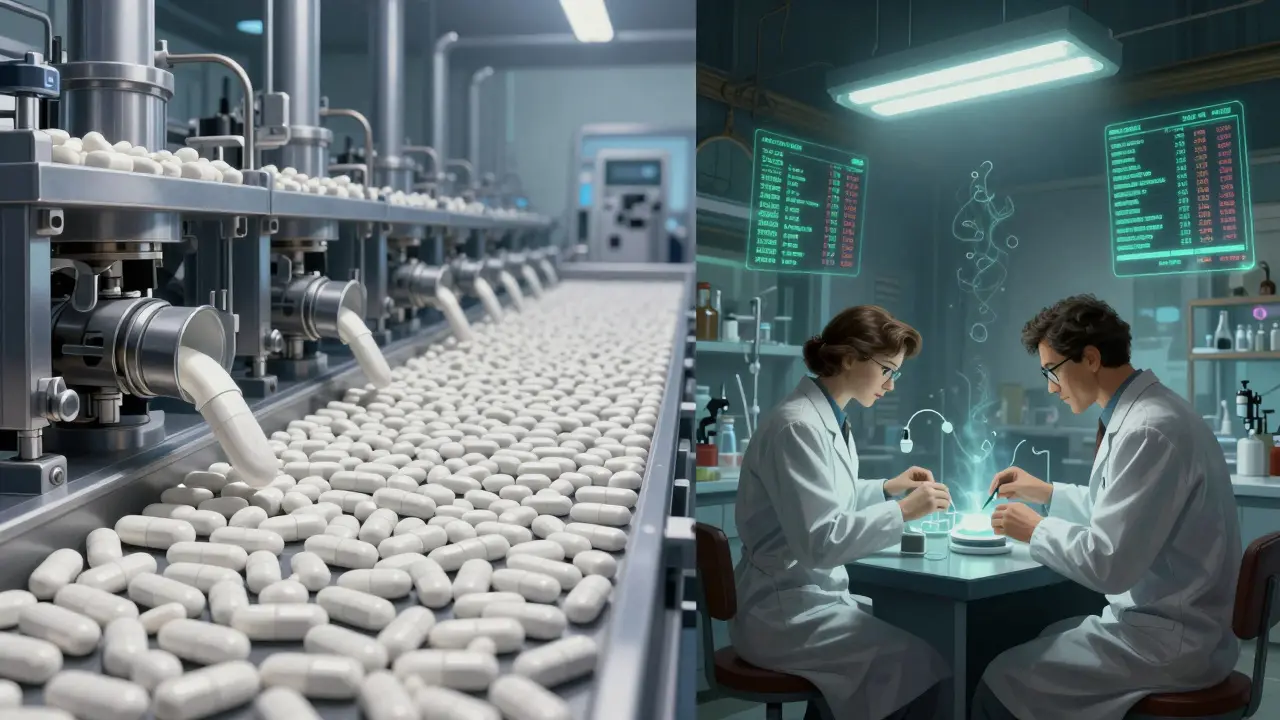
When you pick up a prescription for cholesterol medication or an antibiotic, you might see two options: the brand-name version with a hefty price tag, or a plain white pill with a generic label that costs a fraction. It’s not magic. It’s manufacturing. Generic drugs aren’t just cheaper because they’re less fancy-they’re cheaper because they’re built differently from the ground up. And understanding how they’re made reveals why the entire system works the way it does.
Why Generic Drugs Don’t Need to Spend Millions on R&D
The biggest cost difference between branded and generic drugs starts before the first pill is made. Brand-name companies spend 10 to 15 years and around $2.6 billion to bring a new drug to market. That money goes into discovering the molecule, running dozens of clinical trials, proving safety and effectiveness in thousands of patients, and navigating years of regulatory reviews. It’s expensive, risky, and time-consuming. Generic manufacturers don’t do any of that. Thanks to the 1984 Hatch-Waxman Act in the U.S., they only need to prove their version is bioequivalent-meaning it delivers the same amount of active ingredient into the bloodstream at the same rate as the brand. That’s it. No new trials. No new safety data. Just a few small studies to show the body reacts the same way. This cuts development costs from billions down to $2-5 million. That’s a 99% reduction in upfront investment.How Production Volume Drives Down Unit Costs
Once the drug is approved, the real cost savings kick in during production. Generic companies don’t make one or two versions of a drug-they make hundreds of thousands, sometimes millions, of pills for the same active ingredient. And here’s the key: every time they double their production volume, the cost per pill drops by about 18%. For drugs made in huge quantities, like metformin or lisinopril, that effect compounds over time. Take a common blood pressure pill. If a company produces 100 million tablets a year, each one might cost 40 cents to make. But if they ramp up to 200 million, that cost falls to 33 cents. Hit 400 million? It’s down to 27 cents. That’s not theory-it’s what Boston Consulting Group found after analyzing 15 major generic manufacturers. The bigger the batch, the cheaper the unit. And because generics are often sold in bulk to pharmacies and insurers, volume is everything.The Real Breakdown of Manufacturing Costs
So what actually makes up the cost of a generic pill? It’s not just the active ingredient. Here’s how it breaks down:- Active Pharmaceutical Ingredient (API): This is the actual medicine in the pill. It can make up 30-50% of the total cost. But because generics use the same API as the brand, and because they buy it in massive quantities, they get bulk discounts. API prices can swing 20-30% a year based on global supply-like if a factory in China shuts down-but generic makers lock in long-term contracts to smooth those out.
- Excipients: These are the fillers, binders, and coatings that give the pill its shape and stability. They’re cheap-often pennies per pill-but generic companies buy them in bulk too, driving down the cost further.
- Quality Assurance: Every batch must meet FDA standards. Testing, documentation, and compliance cost about 3-5% of total production. It’s not optional, but it’s standardized. No need to reinvent the wheel.
- Packaging and Labeling: Simple blister packs, basic bottles, and plain labels. No flashy branding, no TV ads, no fancy designs. Just functional packaging.
Why Competition Crushes Prices
The moment a brand drug’s patent expires, the floodgates open. The first generic maker might charge 30-40% less than the brand. But as more companies enter the market, prices drop fast. When only two generics are available, prices are about 54% lower than the brand. When six or more companies are making the same drug? Prices can fall over 95%. That’s why drugs like simvastatin or sertraline cost pennies per dose. It’s not charity-it’s capitalism. Generic manufacturers are locked in a race to the bottom. A 1% improvement in efficiency can mean the difference between staying in business or going under. That’s why companies invest in automation, continuous manufacturing, and lean production. The pressure is relentless.Why Generics Dominate Prescriptions But Not Spending
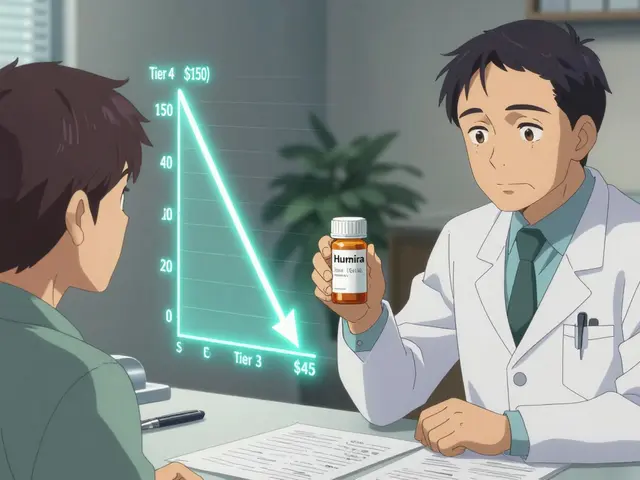
Here’s the paradox: generics make up 90% of all prescriptions filled in the U.S. That’s over 8.9 billion pills a year. But they account for only 15.8% of total drug spending. Why? Because they’re so cheap. The average branded drug costs $150 per prescription. The generic version? $10. Multiply that across billions of doses, and the savings add up fast. The U.S. healthcare system saved $1.7 trillion between 2023 and 2027 thanks to generics, according to IQVIA. That’s not a guess-it’s based on real prescription and pricing data. But here’s the catch: the companies that make these drugs make almost no profit. Their margins are razor-thin. Some generic makers spend half their revenue just on production costs. That’s why many are getting bought by bigger players, or shifting to more complex drugs like inhalers or injectables where entry is harder and competition is lower.
The Hidden Risks and Future Challenges
There’s a dark side to this efficiency. When margins are this tight, supply chains get fragile. If a single API factory in India or China has a quality issue, it can trigger shortages of life-saving drugs. In 2022, there were 350 active drug shortages in the U.S.-many linked to generic manufacturers struggling to maintain production under cost pressure. New regulations like the Inflation Reduction Act could make things harder. Medicare is now allowed to negotiate drug prices, and that includes generics. That could push prices down another 10-15%. At the same time, the FDA is pushing to shorten approval times from 40 months to 24, which sounds good-but it means even more companies will flood the market, driving prices even lower. The future belongs to automation. Companies investing in continuous manufacturing-where pills are made in one long, unbroken process instead of batch by batch-could cut costs another 20-25% by 2027. But that requires big upfront investments. Smaller players might not survive.What This Means for Patients
For you, the patient, this system works. You get the same medicine at a price you can afford. You don’t need to know the chemistry, the supply chain, or the regulatory filings. You just need to know that the generic version works just as well. And it does. The real question isn’t whether generics are cheaper. It’s whether we can keep them that way. As competition grows, as regulations tighten, and as global supply chains shift, the pressure on manufacturers will only increase. But for now, the system holds. Generics aren’t just a workaround-they’re the backbone of affordable healthcare.Are generic drugs as effective as brand-name drugs?
Yes. Generic drugs must meet the same FDA standards as brand-name drugs. They contain the same active ingredient, in the same strength, and work the same way in the body. The only differences are in inactive ingredients (like fillers) and packaging-neither affects how the drug works. Bioequivalence studies prove they deliver the same results.
Why do some people say generics don’t work as well?
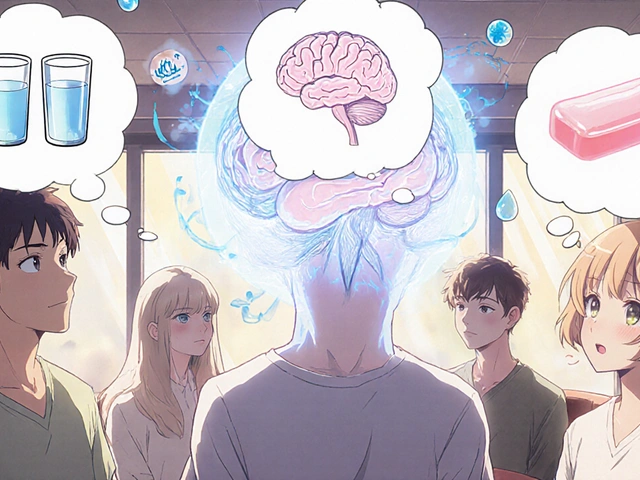
Some patients notice differences in pill size, color, or taste, which can cause psychological discomfort. Others may have had bad experiences with a specific generic manufacturer due to inconsistent quality-though this is rare in the U.S. thanks to strict FDA oversight. In most cases, switching between generics or from brand to generic causes no change in effectiveness. If you feel a difference, talk to your pharmacist or doctor.
Why are generic drugs cheaper if they’re the same?
They’re cheaper because they don’t pay for research, marketing, or advertising. Brand-name companies spend billions developing a drug and then market it heavily to doctors and patients. Generics skip all that. They copy the formula, prove it works the same, and sell it at cost-plus-a-small-margin. Their advantage is volume, efficiency, and competition-not innovation.
Can generic drug quality vary between manufacturers?
All FDA-approved generics must meet the same quality standards. That includes purity, potency, and stability. While packaging or inactive ingredients may differ slightly, the active ingredient is tightly controlled. In rare cases, manufacturing issues can occur-like the 2018 valsartan recall-but these are investigated and corrected. The FDA inspects every facility, and most generic manufacturers are held to the same standards as big pharma.
Why are some generic drugs still expensive?
Some drugs remain expensive because they’re hard to make-like complex injectables, inhalers, or biosimilars. These require advanced technology and face fewer competitors, so prices don’t drop as much. Also, if only one or two companies make a generic, competition is low and prices stay higher. That’s why drugs like insulin or epinephrine auto-injectors still cost hundreds of dollars, even as generics.



Generic drugs aren't cheap because they're inferior-they're cheap because the system is designed to eliminate waste. No marketing, no patent trolling, no shareholder dividends. Just pure, efficient pharma. The real scandal? That brand names ever charged what they did.