When you pick up a generic pill at the pharmacy, you expect it to work just like the brand-name version. That’s not luck. It’s the result of one of the most tightly regulated processes in medicine. The U.S. Food and Drug Administration (FDA) doesn’t just approve generic drugs because they’re cheaper. They approve them because they must meet the same exact standards for safety, quality, and strength as the original brand-name drug.
What Makes a Generic Drug Legally Identical?
It’s not enough for a generic drug to have the same active ingredient. The FDA requires that every generic version matches the brand-name drug in four critical ways: the same active ingredient, the same dosage form (tablet, capsule, injection), the same strength, and the same route of administration (oral, topical, IV). That’s the baseline. But the real test comes down to one thing: how your body absorbs it.
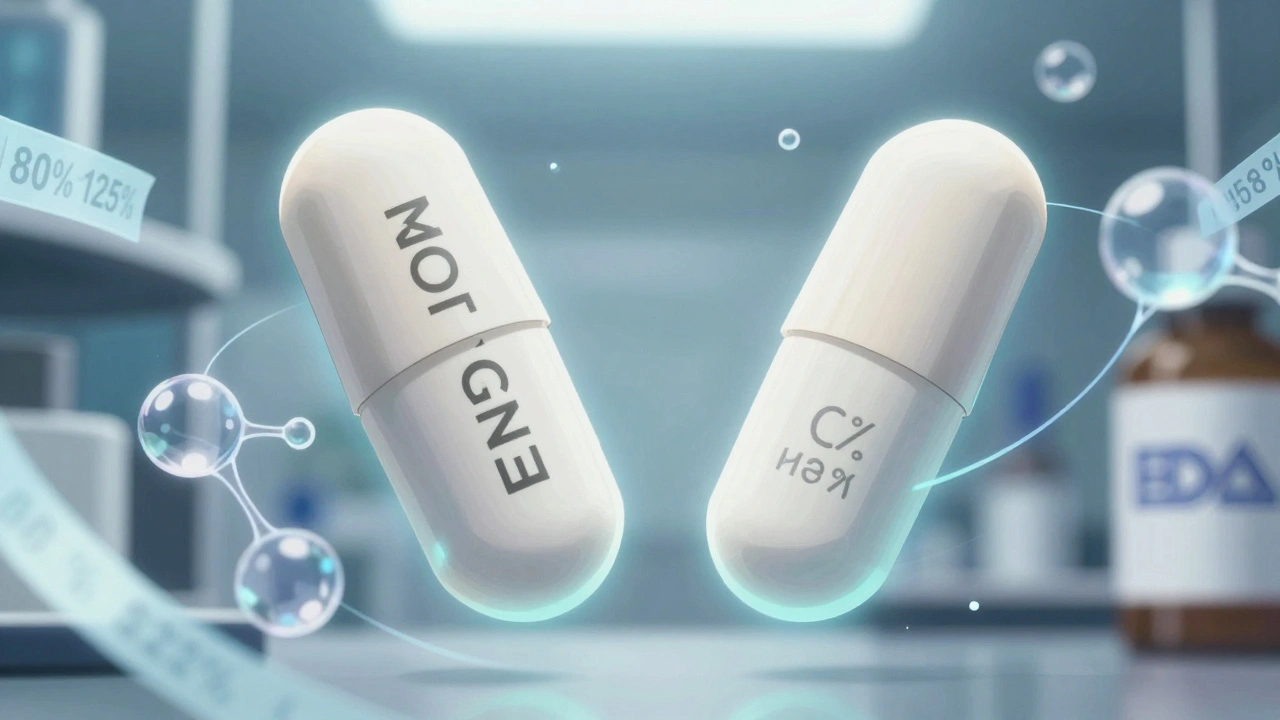
This is where bioequivalence comes in. The FDA doesn’t require new clinical trials for generics. Instead, they require a bioequivalence study - a controlled test in healthy volunteers that measures how quickly and how much of the drug enters the bloodstream. The generic must deliver the same amount of medicine, at the same rate, as the brand-name drug. The acceptable range? Between 80% and 125% of the brand’s absorption levels. That’s not a guess. It’s a scientifically proven window where no clinically meaningful difference in effect or safety has ever been found.
For simple pills like ibuprofen or metformin, this is straightforward. But for complex drugs - like extended-release capsules, inhalers, or topical creams - the rules get stricter. Take Ritalin LA, for example. The FDA doesn’t just look at total absorption. They break it down into time periods: how much is released in the first 3 hours, next 4 hours, and so on. If the generic doesn’t match that exact release pattern, it gets rejected.
Quality Isn’t Optional - It’s Built Into the Factory
Even if a generic drug works the same in your body, it still has to be made right. Every facility that produces generic drugs must follow Current Good Manufacturing Practices (cGMP), which are federal rules written in 21 CFR Parts 210 and 211. These aren’t suggestions. They’re enforceable standards that cover everything from the purity of raw materials to how the machines are cleaned between batches.
The FDA inspects these factories - about 1,200 pre-approval inspections every year. And they don’t just check paperwork. They walk through the facility, look at equipment logs, review batch records, and test samples. In 2021, a generic version of Jardiance was rejected because tablet hardness varied too much across production runs. That’s not a minor issue. Uneven hardness means inconsistent drug release. One pill might dissolve too fast, another too slow. That’s dangerous.
Manufacturers can’t just run one test batch. The FDA expects at least three consecutive commercial-scale batches to prove they can make the same high-quality product, over and over. That’s why many generic companies spend more on quality control than on the actual drug development. As one regulatory executive put it: “You can’t cheat the FDA on manufacturing. They’ve seen it all.”
Strength Isn’t Just About the Dose - It’s About Consistency
When a pill says “10 mg,” it doesn’t mean “about 10 mg.” It means between 95 mg and 105 mg - and every single pill in that bottle must fall in that range. The FDA requires strict control over potency, stability, and purity. If a batch of generic levothyroxine (a thyroid hormone) varies by more than 2% from one pill to the next, it’s rejected. Why? Because even tiny changes in thyroid hormone levels can cause serious health problems - heart palpitations, weight shifts, mood swings.
That’s why the FDA tightened the bioequivalence range for narrow therapeutic index (NTI) drugs like warfarin, lithium, and levothyroxine. Instead of 80%-125%, they now require 90%-111%, and in some cases, even tighter: 95%-105% for levothyroxine. These aren’t arbitrary numbers. They’re based on decades of clinical data showing that even small variations in these drugs can lead to hospitalizations.
And purity matters too. If a generic contains even trace amounts of a contaminant that the brand-name drug doesn’t have - say, a solvent residue or a degradation product - it’s rejected. The FDA doesn’t care if it’s “below toxic levels.” If it’s not in the original, it doesn’t belong in the generic.

Why Do So Many Generic Applications Get Rejected?
Here’s a surprising fact: less than 10% of generic applications get approved on the first try. That’s not because the FDA is being tough. It’s because the bar is set so high.
Most rejections aren’t about safety. They’re about incomplete data, poor study design, or manufacturing inconsistencies. A 2021 analysis found that only 58% of complex generics - like inhalers or injectables - got approved within three tries, compared to 76% for simple pills. Why? Because complex products have more variables. A generic inhaler isn’t just about the drug. It’s about the propellant, the valve, the spray pattern, how much lands in the lungs. If any piece is off, the drug won’t work.
Take the EpiPen. Between 2015 and 2020, the FDA approved only 3 out of 27 generic applications. Not because the drug was wrong - but because the auto-injector device didn’t match the original in force, timing, or needle depth. The FDA treats the device as part of the drug. If it doesn’t deliver the medicine the same way, it’s not equivalent.
And the process takes time. On average, it takes 32.7 months from submission to approval. For complex generics? Nearly 4 years. That’s because the FDA reviews thousands of pages of data - chemistry reports, stability studies, bioequivalence results, manufacturing controls - all of which must be perfectly aligned.
How Do Manufacturers Succeed?
Companies that get approved faster do three things right:
- They talk to the FDA early. The Pre-ANDA program lets manufacturers meet with regulators before submitting. About 78% of successful applicants use this. It’s not a formality - it’s a way to avoid costly mistakes.
- They invest in quality systems. Companies with strong quality management systems have 32% higher first-cycle approval rates.
- They understand the product-specific guidance. The FDA has published over 2,800 detailed guidelines for specific brand-name drugs. If you don’t follow them exactly, your application will fail.
It’s not about cutting corners. It’s about precision. One manufacturer told me: “We spend more time validating our dissolution method than we do on the actual drug synthesis.” That’s the mindset that works.
Are Generics Really the Same?
Some patients worry that generics aren’t as good. But the data says otherwise. The American Medical Association reviewed 15 years of real-world outcomes and found that 98.7% of therapeutic categories showed no difference in clinical results between generics and brand-name drugs. That includes heart meds, antidepressants, diabetes drugs, and seizure medications.
And the savings? Massive. In 2022, generics made up 90.3% of all prescriptions filled in the U.S. - but only 22.8% of total drug spending. That’s $373 billion saved in one year. Without generics, millions of people couldn’t afford their meds.
Even the FDA’s top leaders say it clearly: “Every approved generic meets the same rigorous standards as the brand-name drug,” said former CDER Director Dr. Janet Woodcock. “There are no clinically meaningful differences.”
What’s Changing in 2025?
The FDA is pushing harder to get complex generics approved faster. Their new goal? Approve 50% of complex applications within two review cycles by 2027. Right now, it’s only 28%. That means more generics for drugs like Humira, EpiPen, and Vivitrol - all of which had no generic options just a few years ago.
They’re also improving transparency. More product-specific guidance documents are being published. More pre-ANDA meetings are being scheduled. And the industry is responding. Generic manufacturers are investing more in R&D for complex delivery systems - not to cut costs, but to meet the FDA’s exacting standards.
Meanwhile, patent delays remain a problem. Even after the FDA approves a generic, companies can still be blocked by lawsuits or patent extensions. The FTC found that on average, generic entry is delayed 2.4 years after approval - not because of science, but because of legal tactics.
But the system works. When a generic drug is approved, you can trust it. It’s been tested, inspected, measured, and verified. It’s not cheaper because it’s worse. It’s cheaper because the system is designed to eliminate waste - not safety.
Are generic drugs as safe as brand-name drugs?
Yes. The FDA requires every generic drug to contain the same active ingredient, strength, dosage form, and route of administration as the brand-name drug. They must also prove bioequivalence - meaning your body absorbs them at the same rate and to the same extent. Post-market surveillance over 15 years shows no clinically meaningful safety differences in 98.7% of therapeutic categories.
Why do some people say generics don’t work as well?
Sometimes, people notice differences in pill size, color, or taste - but those are inactive ingredients and don’t affect how the drug works. Rarely, a patient may be sensitive to a filler in a generic, but this is uncommon and usually noticed only after switching from one generic to another. If you feel a difference, talk to your doctor or pharmacist. The drug itself, however, is required by law to be therapeutically equivalent.
How does the FDA ensure generic drugs are made properly?
All manufacturing facilities must follow Current Good Manufacturing Practices (cGMP), and the FDA inspects them before approval - about 1,200 inspections a year. They check everything: raw materials, equipment calibration, batch records, and even how the facility is cleaned. A single inconsistency - like uneven tablet hardness - can delay approval for months.
What’s the difference between a generic and a biosimilar?
Generics are exact copies of small-molecule drugs, like pills or injections with simple chemical structures. Biosimilars are copies of large, complex biological drugs made from living cells - like Humira or insulin. Biosimilars require more testing because they can’t be exactly replicated. The FDA treats them as a different category - not as generics.
How long does it take to get a generic drug approved?
For a standard generic pill, it takes about 32.7 months from submission to approval. Complex products - like inhalers or extended-release capsules - can take nearly 4 years. The FDA aims to complete standard reviews within 10 months after submission, but most applications need revisions before approval, which adds time.
Can a generic drug be recalled after approval?
Yes. Just like brand-name drugs, generics are monitored after approval. If the FDA finds manufacturing problems, contamination, or unexpected side effects, they can issue a recall. In 2021, a generic version of a blood pressure medication was recalled because a manufacturing error led to inconsistent potency. The FDA’s post-market surveillance system catches these issues - even years after approval.




Man, I used to be super skeptical about generics until my dad started taking them for his blood pressure. Saved him like $400 a month and he’s never had a hiccup. The FDA’s got this locked down way better than most people think.