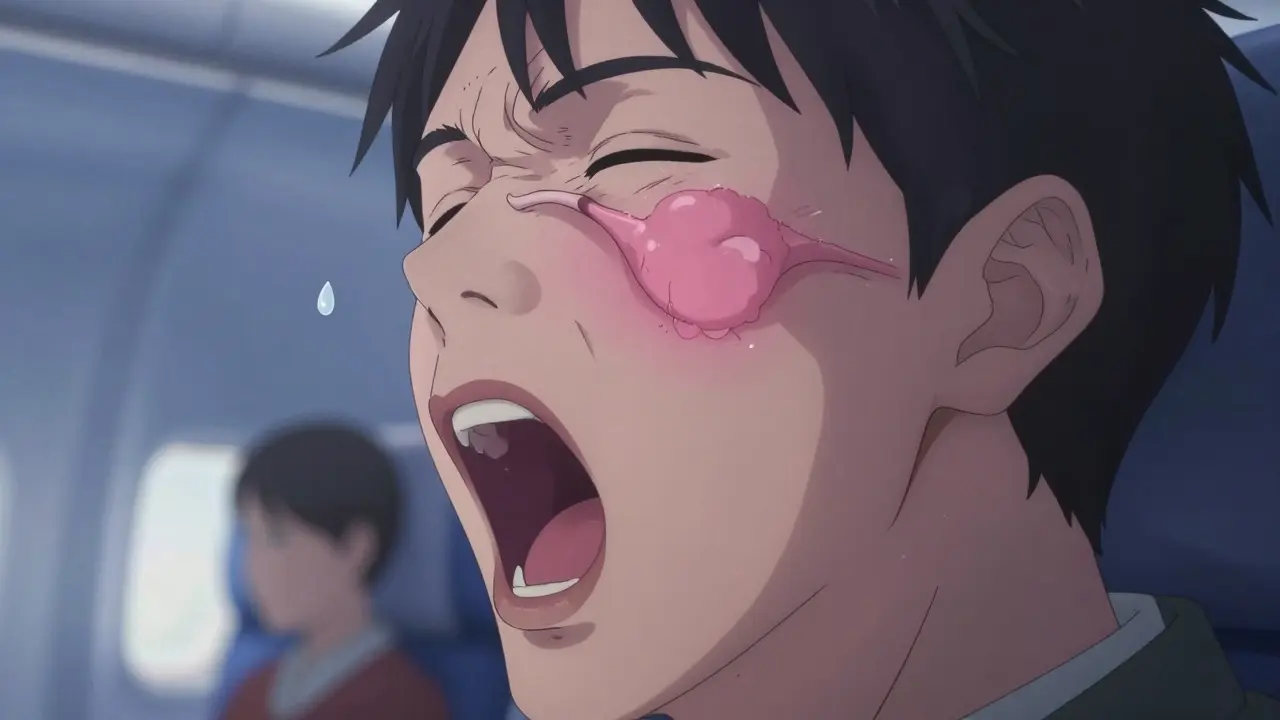
Ever feel like your ears are stuffed with cotton, especially after a cold or during a flight? You’re not alone. Millions of people deal with Eustachian tube dysfunction - a condition that causes ear pressure, muffled hearing, and that annoying pop-click sensation when you swallow. It’s not an infection. It’s not wax. It’s your Eustachian tube failing to do its job: balancing pressure between your middle ear and the outside world.
What Exactly Is the Eustachian Tube?
The Eustachian tube is a tiny canal, about 1.5 inches long, connecting the back of your nose to the middle ear. Its job? Open briefly when you swallow, yawn, or chew to let air in or out of the middle ear. This keeps pressure even on both sides of your eardrum. When it works right, you don’t notice it. When it gets blocked, everything changes.Blockages happen when the tube swells shut - usually from a cold, allergies, or sinus infection. The trapped air in your middle ear gets slowly absorbed by the lining, creating negative pressure. Your eardrum gets pulled inward. That’s what causes the fullness, the dull hearing, and the feeling that your ear is underwater.
Studies show 87% of people with ETD report that ear pressure as their main symptom. Around 92% say their hearing sounds muffled. And 78% hear popping or clicking, especially when they swallow. In some cases, the pressure drop can reduce hearing by 15 to 40 decibels - enough to make conversations fuzzy.
Why Does This Happen?
Most of the time, ETD is a side effect of something else. Upper respiratory infections cause 68% of cases. Allergies are behind 22%. Sinus infections make up the rest. Kids are more prone because their tubes are shorter, narrower, and more horizontal - like a flat pipe instead of a slanted one.Adults get it too, especially those with chronic nasal congestion or frequent flying. Air pressure changes during takeoff and landing can trigger or worsen symptoms. If your tube can’t open fast enough, the pressure difference builds up. That’s why you feel worse on planes, in elevators, or driving through mountains.
It’s not always obvious. A standard ear exam might show a normal-looking eardrum. But if you’ve had pressure for more than a few days - especially after a cold - and no pain, ETD is likely. Constant, sharp pain? That’s probably an infection. ETD rarely causes severe pain.
What Doesn’t Work - and What Might Be Dangerous
A lot of people try to pop their ears by pinching their nose and blowing hard. That’s the Valsalva maneuver. It can help - but only if done right. Blow too hard, and you risk rupturing your eardrum. Do it too often, and you might force bacteria into the middle ear. About 45% of people do it incorrectly the first time.Decongestant nasal sprays like Afrin (oxymetazoline) are common, but they’re not a long-term fix. Using them for more than three days can cause rebound congestion - making your nose stuffier than before. Steroid sprays like Flonase are safer for longer use, but they take days to work. They’re best for allergy-related ETD.
Antibiotics? Not usually needed. The American Academy of Otolaryngology updated its guidelines in 2022 to say: don’t prescribe antibiotics for uncomplicated ETD. It’s not a bacterial infection. Most cases clear up on their own.

What Actually Helps - Simple, Proven Methods
The good news? Most ETD resolves within two weeks without any treatment. But if you want relief now, here’s what works:- Swallowing and yawning - Do it on purpose every 15 to 20 minutes. It’s free, safe, and triggers the tube to open.
- Chewing gum - Keep it going for 10 to 15 minutes every couple of hours. The motion helps the tube open naturally.
- Saline nasal rinses - Use a neti pot or squeeze bottle with sterile water. Clears mucus and reduces swelling around the tube opening.
- The Toynbee maneuver - Pinch your nose, swallow. This pulls air into the middle ear. Works better than blowing for some people.
- Warm compresses - Hold a warm washcloth over your ear. Helps ease discomfort and may reduce swelling.
One Reddit user, u/FrequentFlyerMD, said: “The Valsalva maneuver works like magic for me during flights.” But they also noted it took practice. Start slow. Breathe in deeply, pinch your nose, and blow gently - just enough to feel a slight pop. Don’t strain.
When to See a Doctor
If your symptoms last longer than two weeks, or if you notice:- Severe or constant ear pain
- Fever
- Drainage from the ear
- Sudden hearing loss
- Dizziness or imbalance that doesn’t go away
Then it’s time to see an ENT specialist. These signs could mean an infection, fluid buildup (serous otitis media), or - rarely - something more serious like a tumor in the nasopharynx. That happens in less than 0.5% of cases, but it’s why persistent symptoms need checking.
Doctors can test your ear pressure with a device called a tympanometer. It measures how well your eardrum moves. If it’s stiff from negative pressure, that confirms ETD. They might also check for fluid behind the eardrum using an otoscope or hearing test.

Treatments for Chronic ETD
If you’ve had symptoms for more than three months, you’ve got chronic ETD. That’s when simple tricks stop working. Options include:- Steroid nasal sprays - Used daily for 2 to 4 weeks. Reduces inflammation around the tube opening. Best for allergy-related cases.
- Myringotomy - A tiny cut in the eardrum to drain fluid. Often done with a small tube placed to keep the ear ventilated. Common in kids with recurring fluid.
- Balloon dilation (BDET) - A newer, minimally invasive procedure. A small balloon is inserted through the nose, inflated in the Eustachian tube for 2 minutes, then removed. It widens the tube. Done in-office under local anesthesia. Takes about 20 minutes. Success rates? Around 67% at one year, according to the Oklahoma Sinus Center.
Between 2018 and 2022, balloon dilation use jumped 220%. More ENTs are offering it because patients recover faster than with traditional surgery. No overnight hospital stay. No general anesthesia. Most people go back to work the next day.
What’s Next for ETD Treatment?
Research is moving fast. Bioabsorbable stents - tiny, dissolvable tubes placed inside the Eustachian tube to keep it open - are in Phase II trials. Early results show 85% of patients had symptom improvement within three months. If approved, this could be a game-changer for chronic sufferers.Meanwhile, the trend is clear: less cutting, more precision. Doctors are shifting away from risky, invasive surgeries toward targeted, outpatient procedures. The goal? Restore normal function without damaging the tube.
Final Thoughts: You’re Not Stuck With This
Eustachian tube dysfunction is annoying, but it’s rarely dangerous. Most people get better on their own. The key is patience and smart self-care. Don’t force the Valsalva. Don’t overuse nasal sprays. Swallow more. Chew gum. Rinse your nose. Give it time.If it drags on, don’t ignore it. See a specialist. There are safe, effective options now that didn’t exist five years ago. You don’t have to live with muffled hearing or that constant pressure. Your ears can feel normal again - and you don’t need surgery to make it happen.
Can Eustachian tube dysfunction cause permanent hearing loss?
Usually not. Temporary hearing loss from ETD is common - often 15 to 40 decibels - but it reverses once pressure equalizes. If fluid builds up for more than 3 weeks (called serous otitis media), hearing can drop to 20-50 decibels. Left untreated for months, this can lead to eardrum retraction or scarring, which may cause lasting changes. But permanent hearing loss is rare and mostly happens in cases with long-term, untreated fluid buildup or repeated infections.
Is ETD the same as swimmer’s ear?
No. Swimmer’s ear (otitis externa) affects the outer ear canal - the part you can see. It causes itching, redness, pain when you tug on the earlobe, and sometimes discharge. Eustachian tube dysfunction affects the middle ear - behind the eardrum. It causes pressure, muffled hearing, and popping, but not pain from touching the outer ear. The treatments are completely different.
Why does my ear pop when I swallow, but then it feels blocked again?
That’s classic ETD. Swallowing briefly opens the tube and equalizes pressure - so you hear a pop. But if the tube is swollen or blocked, it shuts right back down. The air in your middle ear gets absorbed again, and pressure drops. You’re not fixing the root problem - you’re just temporarily relieving the symptom. That’s why consistent swallowing, chewing, and nasal care are needed to keep the tube open long-term.
Can stress or anxiety make ETD worse?
Not directly. But stress can lead to jaw clenching, shallow breathing, or reduced swallowing - all of which can make it harder for the Eustachian tube to open. People under stress also tend to ignore symptoms longer or overuse decongestants. Managing stress helps you stick to the right habits - like staying hydrated and doing regular swallowing exercises - which do make a difference.
Are children more likely to get ETD than adults?
Yes. Kids under 7 have shorter, more horizontal Eustachian tubes, which makes them easier to block. They also have weaker immune systems and are more prone to colds and allergies. That’s why ear infections and fluid buildup are so common in young children. Most outgrow it as their tubes grow longer and more vertical. But if a child has repeated fluid buildup, doctors may recommend ear tubes to help with ventilation.
Will flying make my ETD worse?
Almost always. Changes in cabin pressure during takeoff and landing are the #1 trigger for ETD symptoms. If your tube can’t open to equalize pressure, your eardrum gets pulled inward - causing pain, fullness, and muffled hearing. Flying with a cold or allergies makes it much worse. Use decongestants (if appropriate), chew gum, or do the Toynbee maneuver during descent. Avoid flying if you’re actively sick.
Can allergies cause Eustachian tube dysfunction?
Yes - and it’s one of the most common causes in adults. Allergies cause swelling in the nasal passages and around the opening of the Eustachian tube. This blocks airflow. If you get ETD every spring or fall, allergies are likely the trigger. Steroid nasal sprays like Flonase are often the first-line treatment. Avoiding allergens and using saline rinses can help prevent flare-ups.
How long does it take for balloon dilation to work?
Most patients notice improvement within days to a week after the procedure. Full results usually appear by 4 to 6 weeks as the tube heals and stabilizes. Studies show 72% effectiveness at 6 months, and 67% at 12 months. Some people need a second procedure, especially if allergies or chronic sinus issues persist. It’s not a cure-all, but for chronic ETD, it’s one of the most reliable options available.






Okay but like... why are we still treating this like it's 2005? They just did a study where they used a drone to map Eustachian tube dynamics in real time. We're giving people gum and nasal rinses while the tech exists to literally see the tube collapse. It's wild.