When your kidneys start to fail, your body doesn’t just slow down-it starts to swell. Edema in chronic kidney disease (CKD) isn’t just a nuisance. It’s a warning sign that your body is holding onto too much fluid, and if left unchecked, it can lead to breathing trouble, high blood pressure, heart strain, and even hospitalization. The good news? You’re not powerless. A proven, three-part strategy-diuretics, salt restriction, and compression therapy-can help you take control.
Why Edema Happens in CKD
Your kidneys are your body’s water and salt regulators. When they’re healthy, they filter out extra fluid and sodium, sending it out as urine. But when CKD progresses-especially in stages 3 to 5-your kidneys lose that ability. Sodium builds up in your blood. Water follows sodium. And suddenly, fluid leaks out of your blood vessels and pools in your tissues. You’ll notice it most in your ankles, feet, and legs. But it can also show up as puffy eyes in the morning, a bloated belly (ascites), or even shortness of breath if fluid collects around your lungs. This isn’t just about looking swollen. It’s about pressure. Too much fluid means your heart has to work harder. Your blood pressure climbs. Your kidneys get more stressed. And the cycle keeps getting worse.Diuretics: The Medication That Helps You Pee Out the Extra Fluid
Diuretics are often the first line of defense. These are pills-or sometimes IV meds-that tell your kidneys to flush out more sodium and water. But not all diuretics are the same, and which one you use depends on how much kidney function you still have. If your eGFR is below 30 (that’s stage 4 or 5 CKD), loop diuretics like furosemide, bumetanide, or torsemide are the go-to. They’re strong. A typical starting dose is 40-80 mg of furosemide daily. If that doesn’t do enough, your doctor might bump it up by 20-40 mg every few days, sometimes up to 320 mg a day. For some people with advanced CKD, the FDA recently approved an IV form of furosemide. It works faster and clears 38% more fluid than the pill form in people with very low kidney function. If you’re still in stage 2 or 3 CKD (eGFR above 30), thiazide diuretics like hydrochlorothiazide can help. But here’s the catch: if you’re really struggling with fluid retention, your doctor might combine a loop diuretic with a thiazide. This is called sequential nephron blockade. It’s powerful-it can move more fluid than either drug alone. But it also raises your risk of kidney injury by 23%, according to a 2016 NIH study. That’s why it’s only used when absolutely needed and always under close watch. Spironolactone is another option, especially if you also have heart failure. It’s a potassium-sparing diuretic that blocks a hormone causing fluid retention. But in advanced CKD, it can spike your potassium levels dangerously high-over 25% of patients in stage 4 or 5 end up with hyperkalemia. That’s why blood tests are non-negotiable. The big problem with diuretics? They don’t fix the root cause. And they come with trade-offs. People on daily diuretics lose kidney function 3.2 mL/min/year faster than those not on them. There’s also a 47% higher chance of needing dialysis within a year. So while diuretics help you feel better now, they’re not a long-term fix. They’re a tool to manage symptoms while you work on other parts of the plan.Salt Restriction: The Most Powerful Tool You Can Use Every Day
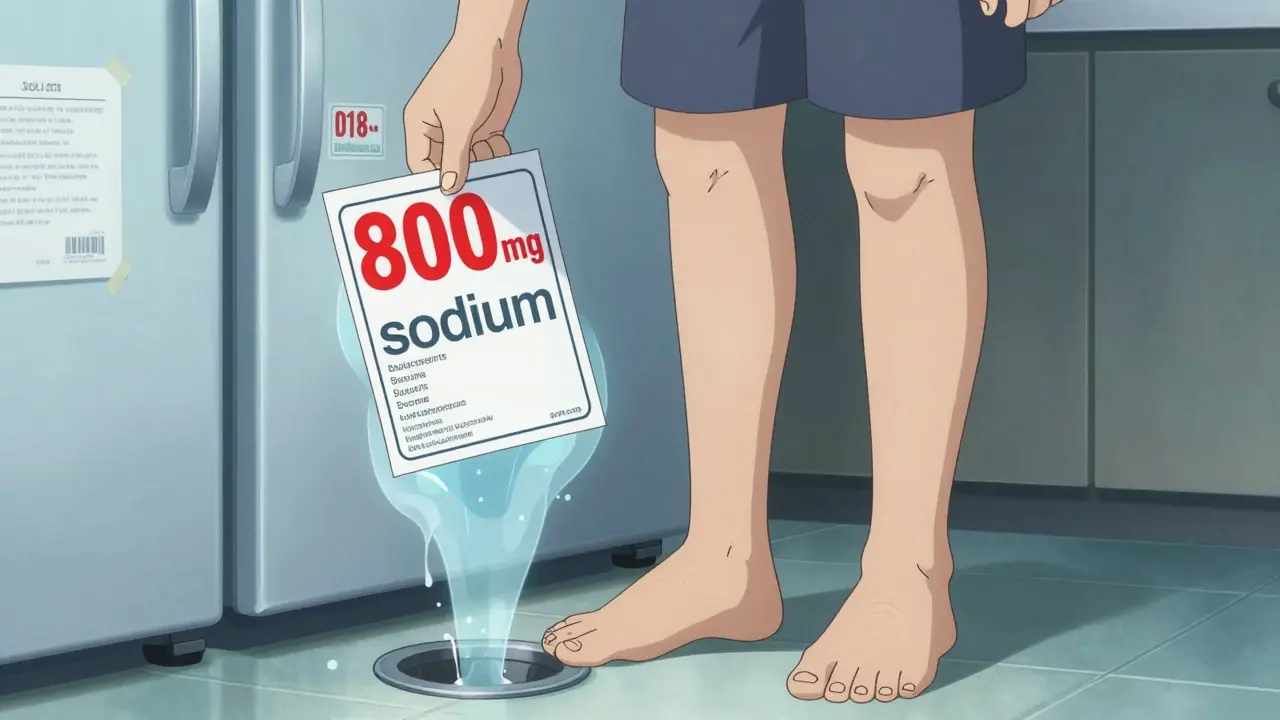
Here’s the truth most people don’t realize: you don’t need to take more pills. You need to eat less salt. The National Kidney Foundation says anyone with CKD and edema should aim for no more than 2,000 mg of sodium per day. That’s about 5 grams of table salt. For advanced CKD, they recommend even less-1,500 mg. Sounds simple, right? It’s not. About 75% of the sodium in your diet comes from processed and packaged foods. You’re not adding it. It’s already there. - Two slices of bread? 300-400 mg sodium. - One cup of canned soup? 800-1,200 mg. - Two ounces of deli meat? 500-700 mg. Even things you think are healthy can be loaded. Yogurt, bread, frozen meals, sauces, and salad dressings are all sneaky sources. A 2022 review by the American Kidney Fund found that people who stuck to a 2,000 mg sodium limit saw a 30-40% reduction in swelling within just 2-4 weeks-without any diuretics. That’s huge. But doing it alone is nearly impossible. That’s why working with a renal dietitian is critical. They teach you how to read labels, swap out high-sodium foods, cook with herbs instead of salt, and handle social situations like restaurants or family dinners. And it’s not just about salt on your plate. Fluids count too. If you have severe edema, your doctor might tell you to limit total daily fluid intake to 1,500-2,000 mL. That includes water, coffee, tea, juice, soup, yogurt, and even fruits like watermelon (which is 92% water). Tracking every sip and bite is the only way to stay in control.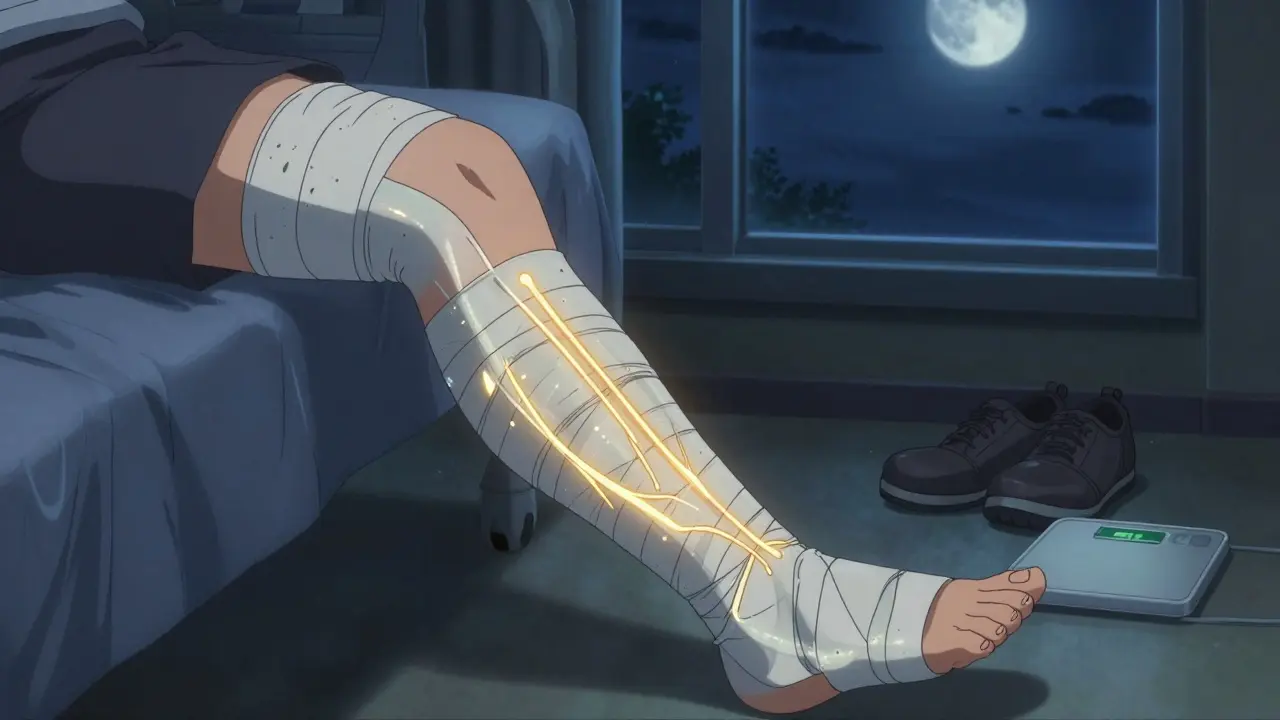
Compression Therapy: When Your Legs Are Swollen, Help Them Drain
Diuretics and salt restriction work from the inside. Compression works from the outside. If your legs, ankles, or feet are swollen, gravity is your enemy. Fluid pools in your lower body because your veins and lymphatic system can’t push it back up. Compression therapy helps by applying pressure-like a gentle squeeze-that pushes fluid back into your bloodstream. Graduated compression stockings (30-40 mmHg at the ankle) are the standard. They’re tighter at your feet and loosen as they go up your leg. Studies show they reduce leg volume by 15-20% after just four weeks. But here’s the catch: only 38% of people keep wearing them past three months. Why? They’re hard to put on, they itch, they feel tight, and they’re expensive. To make them work, you need to pair them with movement. Walking 30 minutes a day, five days a week, improves lymphatic drainage and cuts edema by 22% compared to just resting. Elevating your legs above heart level for 15-20 minutes several times a day also helps-gravity does the rest. For severe cases-especially if you have nephrotic syndrome or massive swelling-intermittent pneumatic compression devices can help. These are machines that wrap around your leg and inflate and deflate in cycles, mimicking muscle movement. One study found they reduced leg circumference 35% more than regular stockings alone.The Real Challenge: Adherence and Real-Life Struggles
Knowing what to do is one thing. Doing it every day is another. On the American Kidney Fund’s online forum, 68% of people with CKD-related edema said they struggle with salt restriction. Taste is the biggest issue. Social events are next. And many say low-sodium food options are hard to find or too expensive. Diuretics cause problems too. Nearly 80% of users say they’re up multiple times at night to pee. That ruins sleep. Muscle cramps and dizziness are common. One in five people have had a fall or fainting spell from low blood pressure. The solution isn’t more pills. It’s more support. People who work with a team-a nephrologist, a dietitian, and a physical therapist-have a 75% success rate controlling edema within eight weeks. Those who go it alone? Only 45% succeed.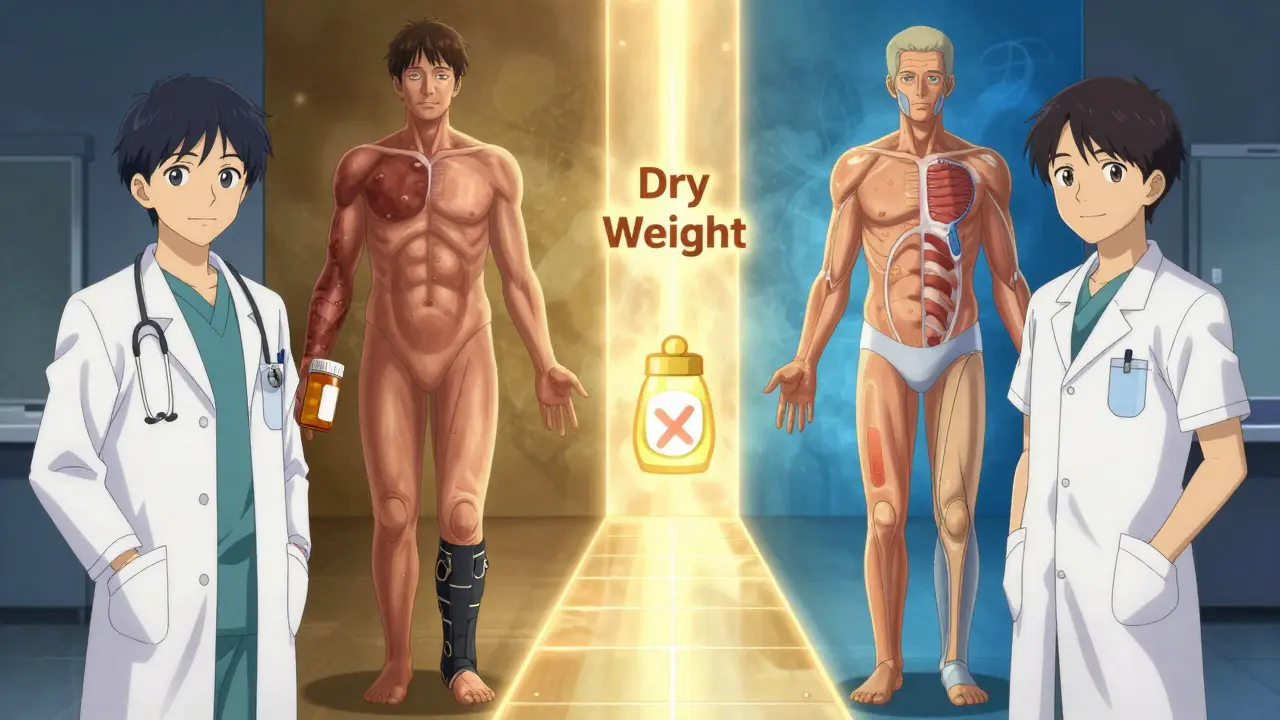
What’s Next? New Tools on the Horizon
Research is moving fast. The NIH-funded FOCUS trial, ending in late 2025, is testing whether using a device called bioimpedance spectroscopy to measure body fluid levels can help doctors tailor diuretic doses more precisely. Early results show it cuts hospitalizations for fluid overload by 32%. New drugs called vaptans (vasopressin receptor antagonists) were once promising, but a 2024 trial was stopped because of liver damage. So for now, the old tools-diuretics, salt control, and compression-are still the gold standard. The next KDIGO guidelines, expected in 2025, may shift the focus from aggressive fluid removal to slower, safer fluid loss-especially in advanced CKD. The goal isn’t to make you dry as a bone. It’s to get you to your ‘dry weight’-the lightest weight you can safely maintain without swelling, dizziness, or cramps.What You Can Do Today
You don’t need to fix everything at once. Start here:- Track your sodium. Use an app or journal to log every meal for three days. You’ll be shocked at how much is hidden.
- Ask for a referral to a renal dietitian. Most insurance covers it.
- Try compression socks. Get 30-40 mmHg graduated stockings. Wear them daily, even if just for an hour.
- Walk 20 minutes a day. It’s the simplest, most effective way to help your legs drain.
- Ask your doctor if your diuretic dose is still right. Many people stay on the same dose for years-even when their kidney function changes.
When to Call Your Doctor
Call immediately if you notice:- Sudden weight gain of more than 2 kg (4.4 lbs) in 2 days
- Shortness of breath, especially when lying down
- Swelling that spreads to your belly or hands
- Confusion, extreme fatigue, or muscle weakness (could be high potassium)
- Signs of low blood pressure: dizziness, fainting, or blurred vision
Edema in CKD isn’t something you just live with. It’s a signal. And with the right mix of medication, diet, and movement, you can manage it-without losing your quality of life.






This is so spot on. I had no idea 75% of sodium comes from processed food. I thought I was doing okay until I tracked my meals. Now I'm reading every label like a detective.