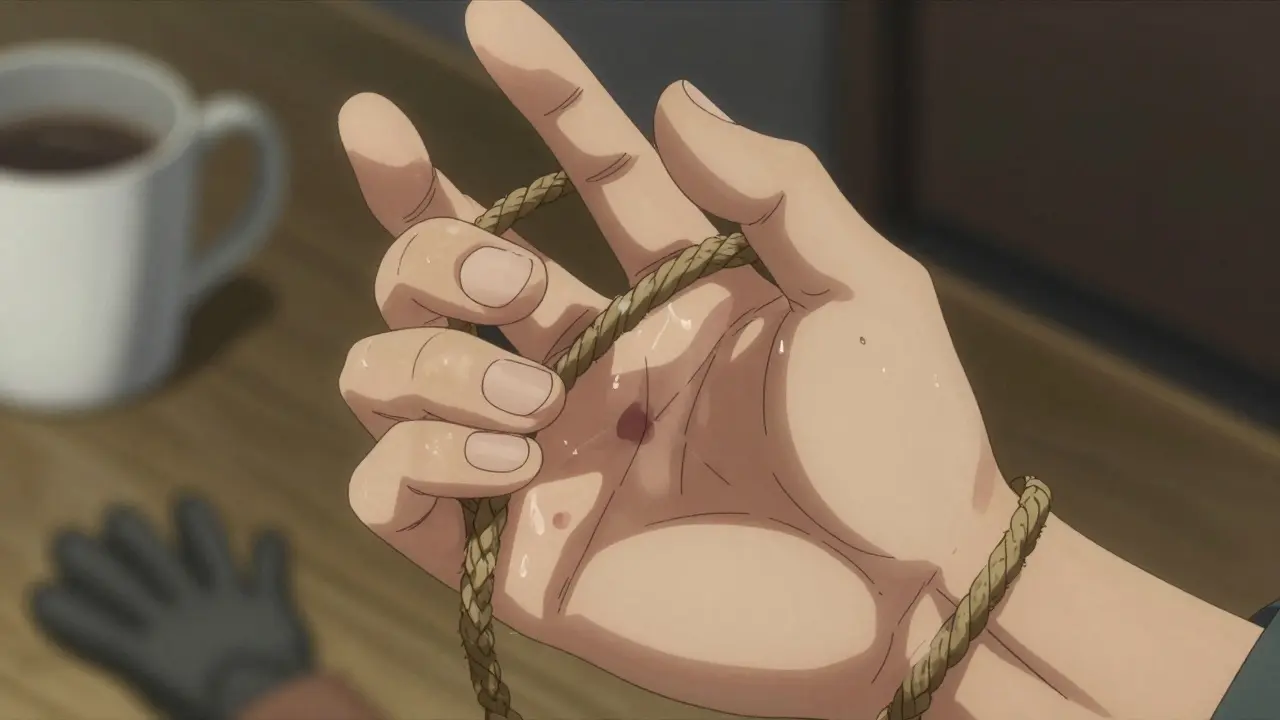
When you can’t lay your hand flat on a table, or your ring finger refuses to straighten no matter how hard you try, it’s not just stiffness-it could be Dupuytren’s contracture. This isn’t a simple case of stiff fingers. It’s a slow, progressive condition where the tissue under your palm thickens, tightens, and pulls your fingers inward. Over time, simple tasks like shaking hands, putting on gloves, or even washing your face become harder. And while it doesn’t hurt at first, the loss of function can be life-changing.
What Exactly Is Dupuytren’s Contracture?
Dupuytren’s contracture starts deep in the palm, where a layer of tissue called the palmar fascia normally supports the hand’s structure. In people with this condition, that tissue begins to form hard lumps-nodules-and then turns into tough cords that act like ropes pulling the fingers down. The ring finger is most often affected (61% of cases), followed by the little finger (54%). It rarely affects the thumb or index finger.
The condition is named after Baron Guillaume Dupuytren, the French surgeon who first described it in 1831. Since then, we’ve learned it’s not caused by overuse or injury. It’s genetic. People with Northern European ancestry-especially those of Scandinavian or Celtic descent-are at highest risk. By age 65, up to 30% of men in this group develop it. Women are less likely to get it, and when they do, it’s usually milder.
There’s no cure. Once the cords form, they don’t go away on their own. But not everyone needs treatment. Many people live with mild nodules for years without losing function. The key is knowing when to act.
How Do You Know If It’s Progressing?
The progression usually happens in stages:
- Stage 1: Small, painless lumps appear near the base of the ring or little finger. These can feel like calluses but don’t move when you press them.
- Stage 2: The lumps connect into cords that run from the palm to the fingers. You might notice dimpling or puckering in the skin.
- Stage 3: Your fingers start bending. You can’t lay your hand flat on a table anymore-that’s called the "table top test," and it’s a simple way to check at home.
- Stage 4: The fingers are permanently bent, often at 45 degrees or more. You can’t grip a steering wheel, hold a cup, or put your hand in your pocket.
Doctors measure contracture in degrees using a goniometer. Intervention is usually considered when the metacarpophalangeal joint (the knuckle) is bent more than 30 degrees, or the proximal interphalangeal joint (the middle knuckle) is bent more than 20 degrees. That’s when function starts to drop significantly.
One in two people with Dupuytren’s will have it in both hands, but one side is almost always worse. And if a close relative has it-your parent, sibling-you have a 68% lifetime risk. That’s why family history matters.
What Treatments Actually Work?
There are three main treatments-each with pros, cons, and costs. Choosing the right one depends on how bad the contracture is, your age, your job, and your tolerance for recovery time.
1. Needle Aponeurotomy (NA)
This is the quickest fix. A doctor uses a needle to puncture the skin and break the cord under local anesthesia. It takes about 15 minutes. You walk out with your fingers straight-often within hours.
Success rate? 80-90% for early-stage cases. It’s cheap-$1,500 to $3,000 per hand. No big incision, no long rehab. But here’s the catch: the cords grow back. About 30-50% of people need another procedure within three years. That’s why it’s best for older patients or those who don’t want long recovery.
One guitar player from Melbourne, who goes by "GuitarGuy42" on a patient forum, said: "I had my ring finger done on a Friday. By Sunday, I was playing again. No cast, no PT. Life changed in two days."
2. Collagenase Injection (Xiaflex)
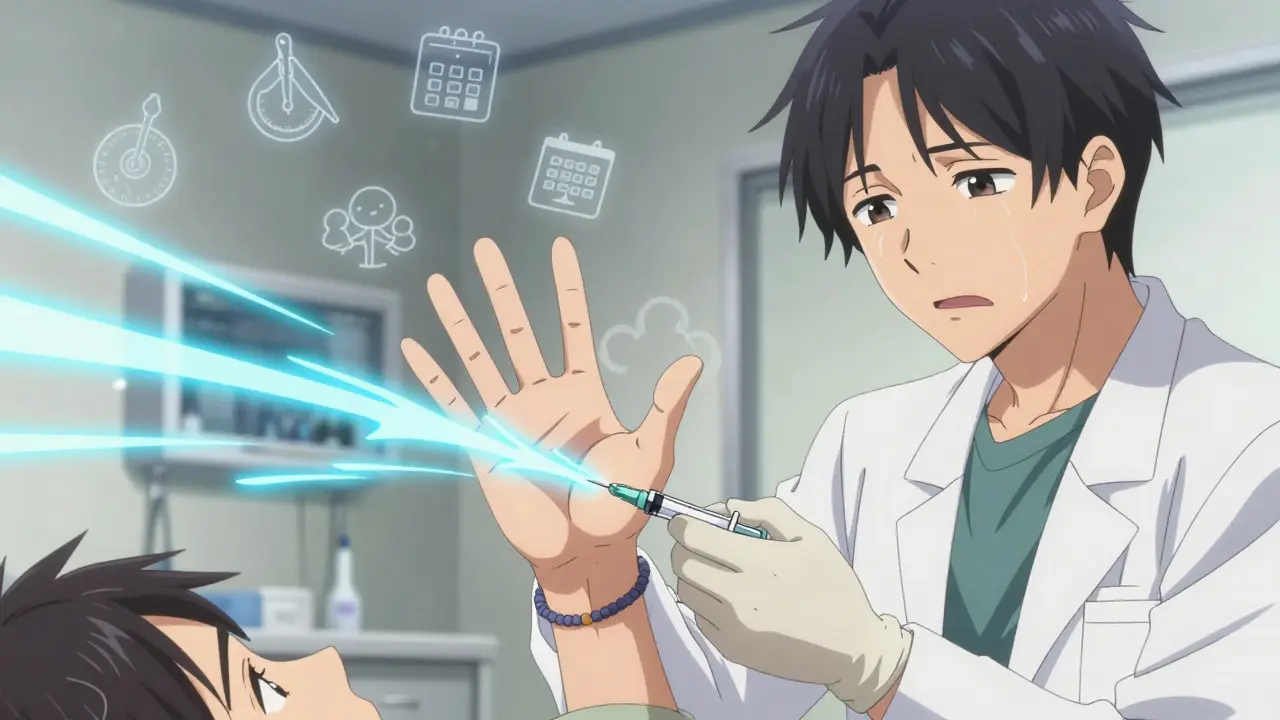
This is a shot of enzyme-collagenase clostridium histolyticum-that dissolves the cord. You get the injection, wait a day, then the doctor manually straightens your finger. It’s done in the office. No surgery.
Success rates are 65-78% for knuckle contractures. But it’s expensive: $3,500 to $5,000 per injection. And you have to follow the protocol exactly: stretch your finger 4-6 times a day for a week. If you don’t, success drops from 85% to 65%.
Side effects? Swelling, bruising, and sometimes skin tears. One Reddit user wrote: "The pain during straightening felt like my finger was being ripped apart. But after two weeks, I could hold my grandkids again. Worth it."
3. Surgery: Fasciectomy
This is the old-school option. The surgeon cuts out the abnormal tissue. There are two types:
- Limited fasciectomy: Removes only the diseased tissue. Recurrence rate: 20-30% in five years.
- Dermofasciectomy: Removes both the cord and the overlying skin, then grafts new skin. Recurrence drops to 10-15%, but recovery takes 3-6 months.
Surgery costs $8,000 to $15,000. Recovery involves weeks of physical therapy, splinting, and strict exercises. Complications include nerve damage (3-5% of cases), infection, and stiffness. But for younger, active patients with severe contracture, it’s often the best long-term bet.
What Doesn’t Work (And Why)
There’s a lot of misinformation out there.
Corticosteroid injections? They might help if your nodules are painful in the early stage, but they don’t stop the cords from forming. Studies show only 30% respond, and repeated shots can thin the skin.
Dupuytren’s gloves or splints? They’re marketed as "non-surgical cures," but most patients report little to no improvement. A 2023 survey of 1,542 users found 28% had skin breakdown from constant stretching. They don’t reverse contracture.
Stretching alone? If you’re already at Stage 3 or 4, stretching won’t straighten your fingers. It might help maintain motion after treatment, but it won’t fix the problem.
Recovery and Rehab: The Real Work Begins After Treatment
Treatment is just the start. The real challenge is keeping your fingers straight after the procedure.
After needle aponeurotomy or collagenase, you’ll need to stretch your fingers 4-6 times a day for at least six weeks. That’s 5-10 minutes per session. Studies show patients who stick to this regain 95% of their motion. Those who skip it? Only 75%.
After surgery, physical therapy is non-negotiable. Two to three sessions a week for 6-8 weeks. Splints worn at night. Exercises for grip, pinch, and extension. Skipping rehab is the #1 reason people lose the gains they worked so hard for.
And it’s not just about movement. Grip strength drops by an average of 35% in untreated cases. That affects everything-from opening jars to typing to holding tools. Manual laborers are hit hardest: they’re 3.2 times more likely to lose work capacity than office workers.
What’s Coming Next?
The future of Dupuytren’s treatment is moving fast.
Gene therapy targeting TGF-β1-a protein that drives tissue scarring-is already in early trials. One study showed a 40% reduction in cord thickness after six months. Ultrasound-guided devices like the "Fasciotome" are cutting procedure time from 30 minutes to 12. And stem cell therapies using fat tissue are being tested to prevent recurrence.
The U.S. and EU have 17 million people with Dupuytren’s. That number is growing by 1.3% each year as the population ages. The treatment market is worth $450 million-and it’s expected to grow 6.8% annually through 2028.
But here’s the truth: no new treatment will replace the basics. Early detection. Knowing your limits. Choosing the right intervention. And sticking with rehab.
When to See a Doctor
You don’t need to panic if you feel a lump. But if you notice any of these, make an appointment:
- You can’t lay your palm flat on a table
- Your fingers are bending more than 20-30 degrees
- You’re having trouble with daily tasks-buttoning shirts, shaking hands, holding a phone
- You have a family history and new nodules are forming
Don’t wait until your fingers are locked. Early evaluation means more options-and better outcomes.
Is Dupuytren’s contracture hereditary?
Yes. Genetics play a major role. If one of your parents has Dupuytren’s, your lifetime risk jumps to 68%. People with Northern European ancestry-especially from Scandinavia, the UK, or Ireland-are most affected. Genome studies have identified 11 gene variants linked to the condition, which together explain about 25-30% of why some people develop it.
Can Dupuytren’s contracture go away on its own?
No. Once the cords form and start pulling the fingers down, they don’t reverse without treatment. Some people have slow progression and may never lose function, but the tissue changes are permanent. Watchful waiting is okay if your fingers still work-but don’t assume it will disappear.
What’s the best treatment for early-stage Dupuytren’s?
For early-stage (Stage 1-2), no treatment is usually needed unless it’s painful. If you’re developing cords but still have full finger movement, your doctor may recommend monitoring. Treatment is typically considered only when contracture reaches 30 degrees or more at the knuckle. At that point, needle aponeurotomy is often the first choice for its low cost and quick recovery.
Can I prevent Dupuytren’s contracture?
No. There’s no proven way to prevent it. Smoking, diabetes, and heavy alcohol use are sometimes linked to worse outcomes, but they don’t cause it. Avoiding hand trauma won’t help either. The only real prevention is early detection-know your family history and check your palms regularly.
How long does recovery take after surgery?
Recovery depends on the type of surgery. After a limited fasciectomy, most people return to light work in 4-6 weeks and full activity in 8-12 weeks. Dermofasciectomy, which involves skin grafts, takes longer-3 to 6 months. Physical therapy is essential. Without it, stiffness and scar tissue can limit movement even after the surgery is successful.
Is Dupuytren’s contracture dangerous?
It’s not life-threatening, but it can be disabling. As fingers contract, daily tasks become difficult. Studies show 89% of patients struggle with gripping, 76% have trouble with hygiene, and 42% of working-age patients report reduced job performance. For manual workers, it can mean losing their livelihood. The real danger is delay-waiting too long reduces treatment options and makes recovery harder.




My aunt had this and they cut her hand open and she couldn’t use it for months. I swear I still see her trying to shake hands and her fingers just curl like claws. It’s terrifying to watch someone lose something so basic.