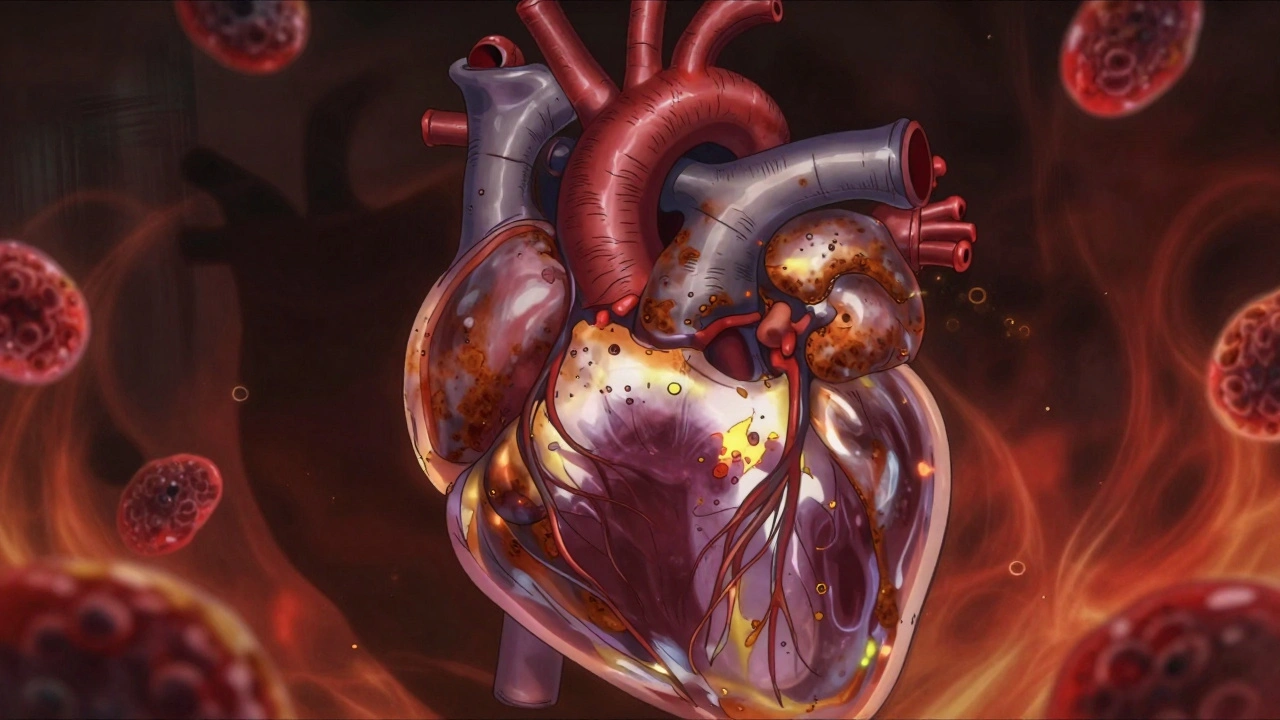
Coronary artery disease isn’t a sudden event-it’s a slow burn. For years, fatty deposits quietly build up inside the arteries that feed your heart. No symptoms. No warning. Then, one day, the heart doesn’t get enough oxygen, and chest pain hits. Or worse-something far more serious. This is atherosclerosis in action, the root cause of coronary artery disease (CAD), the number one killer worldwide.
What Exactly Is Atherosclerosis?
Atherosclerosis is the process where cholesterol, fat, calcium, and other substances stick to the inner walls of your arteries. Over time, these deposits form plaques. Think of it like rust building up inside a water pipe. At first, the pipe still works. But as the rust thickens, water flow slows. Eventually, it can clog completely. In the heart, this means the coronary arteries-your heart’s lifelines-get narrower. The plaques aren’t always the same. Some are hard and stable, slowly blocking blood flow. These often cause predictable chest pain during exercise, known as stable angina. Others are soft, unstable, and packed with fat and inflammatory cells. These can rupture without warning, triggering a blood clot that blocks the artery entirely-and that’s when a heart attack happens. What’s surprising? The most dangerous plaques don’t always block more than half the artery. Sometimes, they’re under 50% narrowed. But because they’re fragile, they’re the ones that cause sudden cardiac events. Meanwhile, larger blockages that have been around for years often just cause steady, manageable symptoms.Who’s at Risk? The Real Culprits Behind CAD
It’s not just about being overweight or eating too much fried food. While those things matter, the real risk factors are more complex-and often hidden. High LDL cholesterol is the main fuel for plaque. But it’s not just the amount-it’s how long it stays in your blood. If your body can’t clear it efficiently, it starts sticking to artery walls. High blood pressure damages the lining of arteries, making it easier for cholesterol to lodge in. Diabetes is especially dangerous because it doesn’t just raise blood sugar-it also makes blood vessels inflamed and sticky. Smoking is one of the fastest ways to wreck your arteries. It reduces oxygen, raises blood pressure, and directly damages the inner lining of blood vessels. Even secondhand smoke increases risk. Family history plays a big role. If a close relative had a heart attack before age 55 (men) or 65 (women), your risk goes up-even if you eat well and exercise. Genetics can influence cholesterol levels, how your body handles inflammation, and even how your arteries respond to stress. Age is unavoidable. After 45 for men and 55 for women, risk climbs steadily. But now, we’re seeing more people in their 30s and 40s with advanced plaque buildup due to poor diet, inactivity, and obesity. Chronic kidney disease is often overlooked. When kidneys don’t filter well, toxins build up, blood pressure rises, and inflammation increases-all speeding up plaque formation. And here’s the kicker: over 60% of people with CAD have high-risk features-like multiple blocked arteries, heart failure, or diabetes. Yet, nearly 75% of all heart attacks happen in this group. That’s why knowing your risk level isn’t optional-it’s life-saving.
How Is CAD Diagnosed?
You can’t see plaque with the naked eye. So doctors use tools to find it before it’s too late. An electrocardiogram (ECG) is usually the first test. It measures the heart’s electrical activity. If a part of the heart isn’t getting enough blood, the pattern changes. But a normal ECG doesn’t rule out CAD-it just means no active damage is happening at that moment. A stress test shows how your heart handles physical demand. You walk on a treadmill or take medication to simulate exercise while your heart is monitored. If your heart doesn’t get enough oxygen under stress, it shows up as abnormal patterns on the ECG or imaging. The gold standard is coronary angiography. A thin tube is threaded into an artery in your wrist or groin and guided to your heart. Dye is injected, and X-rays show exactly where blockages are. It’s invasive, but it gives the clearest picture. For people with suspected blockages in leg arteries (which often go hand-in-hand with heart disease), doctors check the Ankle-Brachial Index (ABI). It compares blood pressure in your ankle to your arm. A lower number in the ankle suggests poor circulation elsewhere-including the heart.Treatment: It’s Not Just Pills
There’s no magic cure. But the good news? You can stop CAD from getting worse-and even reverse some damage. Lifestyle changes are the foundation. Not a suggestion. A requirement. A heart-healthy diet means more vegetables, whole grains, fish, nuts, and olive oil. Less red meat, sugar, and processed foods. Regular exercise-150 minutes a week of brisk walking or cycling-lowers blood pressure, improves cholesterol, and reduces inflammation. Medications are often necessary. Statins lower LDL cholesterol and actually help stabilize plaques so they’re less likely to rupture. Blood pressure meds like ACE inhibitors or beta-blockers reduce strain on the heart. Aspirin or other antiplatelet drugs prevent clots. For diabetics, strict glucose control is part of heart protection. If lifestyle and meds aren’t enough, procedures come in. Percutaneous coronary intervention (PCI) is a minimally invasive procedure. A balloon is inflated inside the blocked artery to open it. Then, a metal mesh tube-a stent-is placed to keep it open. Most people go home the next day. Coronary artery bypass grafting (CABG) is open-heart surgery. A healthy blood vessel from your leg, arm, or chest is grafted onto the coronary artery, bypassing the blockage. It’s major surgery, but for people with multiple blockages or diabetes, it often lasts longer than stents. The 2023 guidelines from the American Heart Association and American College of Cardiology stress one thing: personalized treatment. Your treatment plan should match your risk level. Someone with a 2% yearly risk of heart attack needs different care than someone with a 7% risk. It’s not one-size-fits-all.







So let me get this straight - we’re telling people to eat kale and walk 150 minutes a week like it’s some kind of miracle cure? Meanwhile, Big Pharma is selling statins like candy and the FDA approves new drugs based on surrogate endpoints. This whole thing is a money machine disguised as medicine.