Every year, the FDA approves hundreds of generic drugs - and each approval saves the U.S. healthcare system billions. But the numbers aren’t steady. Some years, savings spike. Others, they drop. Why? It’s not random. It’s tied to which brand-name drugs lose patent protection. When a blockbuster drug goes generic, the price doesn’t just drop a little - it plummets by more than 70%. That’s where the real savings happen.
How the FDA Measures Savings from New Generic Approvals
The FDA doesn’t just count how many generic drugs get approved. It tracks the actual money saved in the first 12 months after each approval. This is called the first-generic savings metric. It measures the difference between what patients and insurers paid for the brand-name version before approval and what they paid after generics entered the market.
Here’s how it works: When a new generic hits the shelves, the brand-name drug usually lowers its price to stay competitive. The FDA calculates savings from two sources: the volume of the generic drug sold at a lower price, and the reduced sales of the brand-name drug at its new, lower price. For example, if a drug used to cost $500 a month and a generic version drops it to $120, every prescription filled with the generic saves $380. Multiply that by millions of prescriptions, and you get billions.
This method gives a clear picture of the immediate economic impact of each new generic entry. It’s not about how many generics are in use overall - it’s about the shockwave created when a new competitor enters a market that was once monopolized.
Year-by-Year Breakdown: The Real Numbers
The savings from new generic approvals don’t follow a smooth trend. They jump and dip depending on which drugs come off patent.
- 2018: $2.7 billion in savings from first-time generic approvals
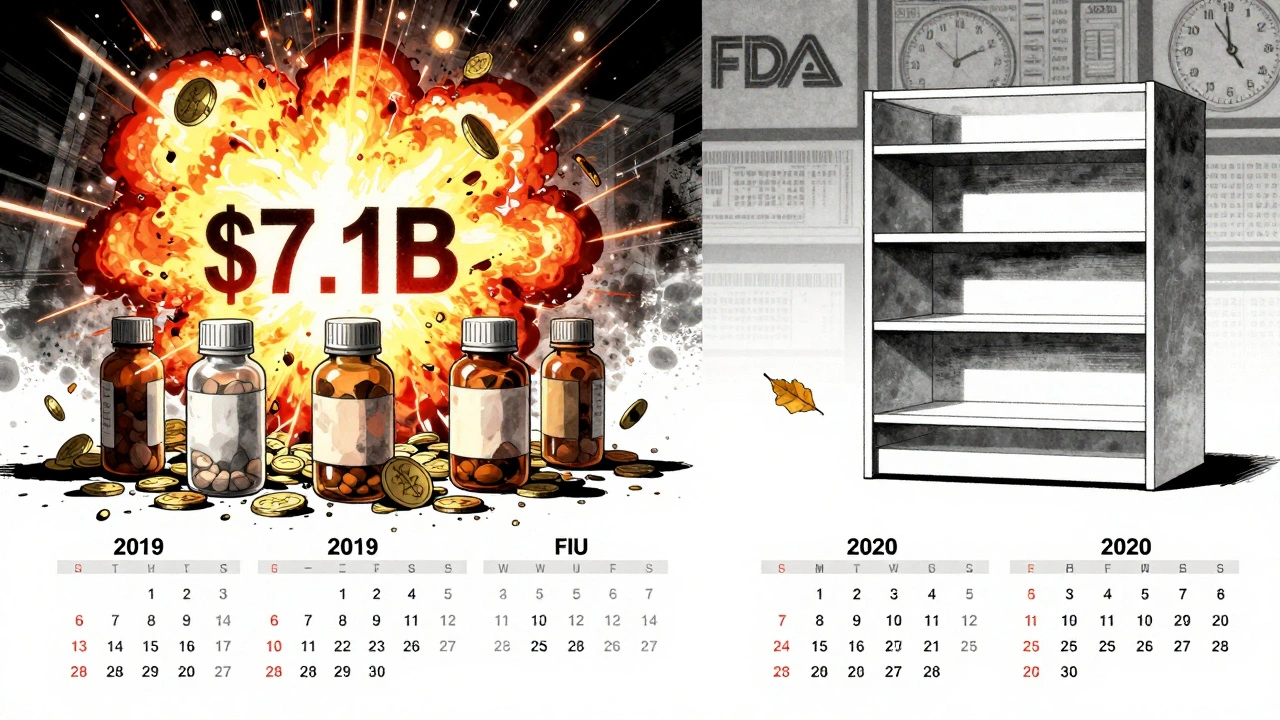
- 2019: $7.1 billion - the highest year on record, thanks to several high-cost drugs going generic
- 2020: $1.1 billion - a sharp drop, as fewer major drugs lost patent protection
- 2021: $1.37 billion
- 2022: $5.2 billion - a major rebound, driven by approvals in large therapeutic markets
What caused the 2019 spike? Five drugs accounted for nearly half of the $7.1 billion in savings that year. One of them was a cholesterol medication that had been priced at over $1,000 per month. After generic approval, it dropped to under $10. That’s not a discount - that’s a revolution.
The 2022 surge was different. Instead of one or two big winners, several mid-sized drugs - each with millions of users - went generic at once. That’s why the savings rebounded even without a blockbuster. It’s not always about the biggest drugs. Sometimes, it’s about the most commonly used ones.
Total Generic Savings: What the Market Actually Saves
The FDA’s numbers show the impact of new approvals. But they don’t show the full picture. For that, you need the Association for Accessible Medicines (AAM). They track the total savings from all generic drugs in use during a calendar year - not just the new ones.
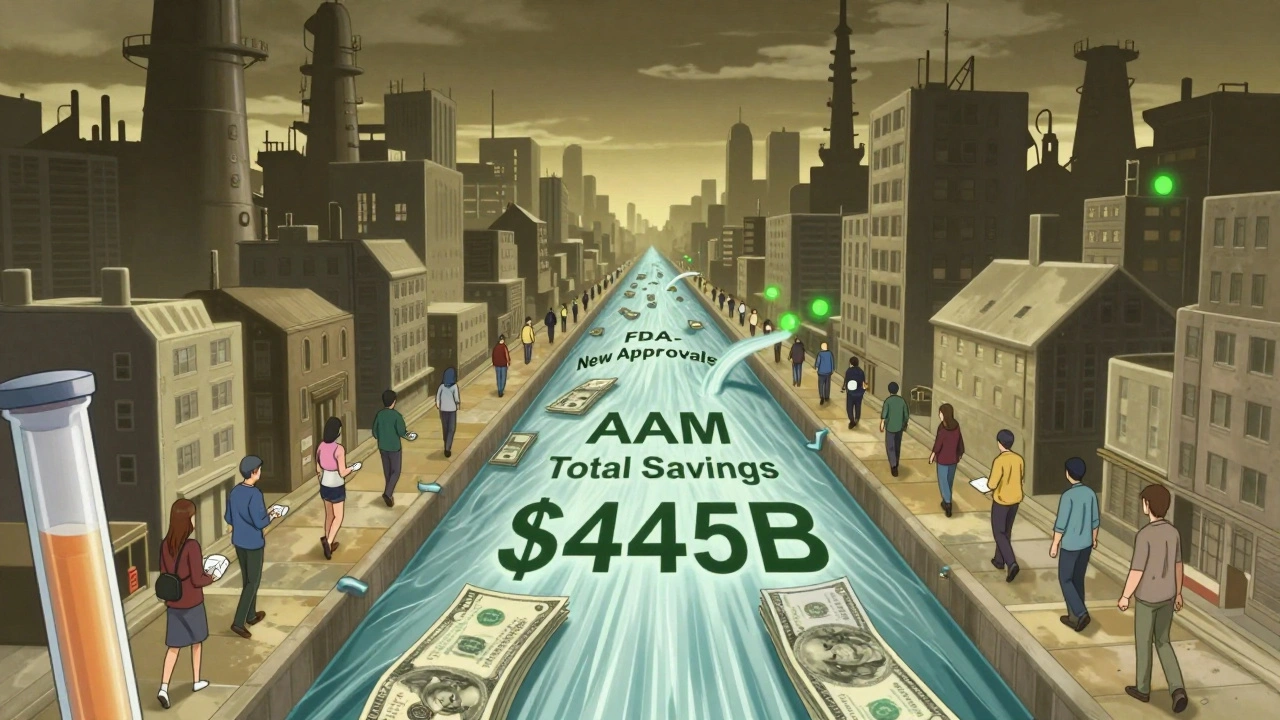
In 2023, generics saved the U.S. healthcare system $445 billion. That’s not a typo. That’s $445 billion in one year. Since 2014, generics have saved $3.1 trillion. To put that in perspective, that’s more than the entire annual GDP of Australia.
Here’s how that money breaks down by payer:
- Commercial insurance: $206 billion
- Medicare: $137 billion (an average of $2,672 saved per beneficiary)
- Medicaid: $102 billion
Therapeutic areas show where the biggest savings are happening:
- Heart disease: $118.1 billion
- Mental health: $76.4 billion
- Cancer: $25.5 billion
These aren’t theoretical numbers. They’re real dollars taken out of patients’ pockets. A person on a $500-a-month blood pressure medication might now pay $10 for the generic. That’s not just a savings - it’s a lifeline.
Why the Gap Between FDA and AAM Numbers?
It’s easy to be confused. The FDA says $5.2 billion in savings in 2022. AAM says $445 billion. Which one’s right? Both. They’re measuring different things.
The FDA looks at the savings from drugs approved that year - only their first 12 months on the market. The AAM looks at every generic drug being used that year, no matter when it was approved. That’s why the AAM numbers are so much bigger.
Think of it like a river. The FDA measures the water flowing in from new tributaries each year. The AAM measures the total volume of the river downstream. One shows the new inputs. The other shows the full flow.
That’s why the FDA’s 2022 report says the cumulative savings from generics approved in 2018, 2019, and 2020 added up to $53.3 billion. Those drugs are still being used today - and still saving money every single day.
Who Benefits the Most?
Patients aren’t just saving money - they’re saving their health. In 2019, 92% of generic prescriptions were filled for $20 or less. The average copay? $6.97. Compare that to brand-name drugs, where copays often hit $100 or more.
But here’s the catch: not all savings reach the patient. Pharmacy benefit managers (PBMs) negotiate rebates with drugmakers. A 2023 Senate investigation found that only 50-70% of the savings from generics actually make it to the consumer. The rest gets absorbed by middlemen.
State Medicaid programs have seen huge wins. California’s Medi-Cal program saved $23.4 billion in one year. Alaska, with a much smaller population, saved $354 million. The savings scale with population size - but the impact is just as real in small states.
How Generics Changed the Game
Generics now make up 90% of all prescriptions filled in the U.S. But they account for just 13.1% of total drug spending. That’s the power of competition. Without generics, the U.S. would be spending over $3 trillion more on prescriptions every year.
The Hatch-Waxman Act of 1984 created the legal pathway for generics. Back then, the FDA approved 1,050 applications in its first year under the new rules - and projected $1 billion in annual savings. Today, that number is over $400 billion. The system works - but it’s under pressure.
Brand manufacturers now use tactics like patent thickets, REMS restrictions, and settlement deals to delay generic entry. The FDA’s 2023 Drug Competition Action Plan is trying to crack down on these practices. But progress is slow.
What’s Next for Generic Savings?
The future of savings depends on two things: patent cliffs and complexity.
More blockbuster drugs are losing patent protection. Drugs like Humira, which brought in $20 billion a year, are now open to generic competition. That could push annual savings past $500 billion by 2030.
But not all drugs are easy to copy. Biologics - complex, injectable drugs used for cancer, arthritis, and autoimmune diseases - are harder and more expensive to replicate. Biosimilars (the generic version of biologics) have been slow to catch on. As of August 2024, the FDA had approved only 59 biosimilars. Their savings are still modest compared to traditional generics.
Still, the trend is clear: generics are the backbone of affordable healthcare. Every approval, no matter how small, adds up. And every dollar saved means one more patient can afford their medication.
Why This Matters to You
If you or someone you know takes medication regularly, generic drugs are the reason you can still afford it. They’re why a $1,200 monthly insulin prescription became a $40 one. They’re why someone with high blood pressure doesn’t have to choose between medicine and groceries.
The numbers are big. But the real impact is personal. A single generic approval can change a family’s financial future. That’s why tracking these savings isn’t just about economics - it’s about justice.
When a drug goes generic, it’s not just a business decision. It’s a public health win.
How much do generic drugs save patients annually?
In 2023, generic drugs saved the U.S. healthcare system $445 billion. On average, patients paid 80-90% less for generics than brand-name drugs. For many, that means out-of-pocket costs dropped from over $100 a month to under $10.
Why do generic savings vary so much from year to year?
Savings spike when high-cost brand-name drugs lose patent protection. In 2019, savings hit $7.1 billion because several multi-billion-dollar drugs went generic. In 2020, savings dropped to $1.1 billion because fewer major drugs lost patents. It’s not about how many generics are approved - it’s about how expensive the drugs were before.
Do generic savings always mean lower prices for patients?
Not always. While generics are cheaper, pharmacy benefit managers (PBMs) often keep a large portion of the savings through rebates. A 2023 Senate report found only 50-70% of generic savings reach patients directly. Insurers and government programs benefit more than individuals in some cases.
What’s the difference between FDA and AAM savings numbers?
The FDA tracks savings from drugs approved in a given year - only during their first 12 months on the market. The AAM tracks total savings from all generic drugs in use that year, regardless of when they were approved. That’s why AAM’s numbers ($445 billion in 2023) are much larger than the FDA’s ($5.2 billion for new approvals).
Are biosimilars as cost-effective as traditional generics?
Not yet. Biosimilars - the generic version of complex biologic drugs - are harder and more expensive to develop. As of August 2024, the FDA had approved only 59 biosimilars. While they’re saving money, their impact is still small compared to traditional generics, which have saved trillions over the past decade.
Which states save the most from generic drugs?
California leads with nearly $38 billion in annual savings from generics. Other high-savings states include Texas, New York, and Florida - all with large populations. Smaller states like Alaska still save hundreds of millions, proving that even modest populations benefit significantly from generic access.




Bro this is wild. I took my dad's blood pressure med last month and it was $8 instead of $150. No joke. Generics saved our family from bankruptcy. Why are we even debating this?